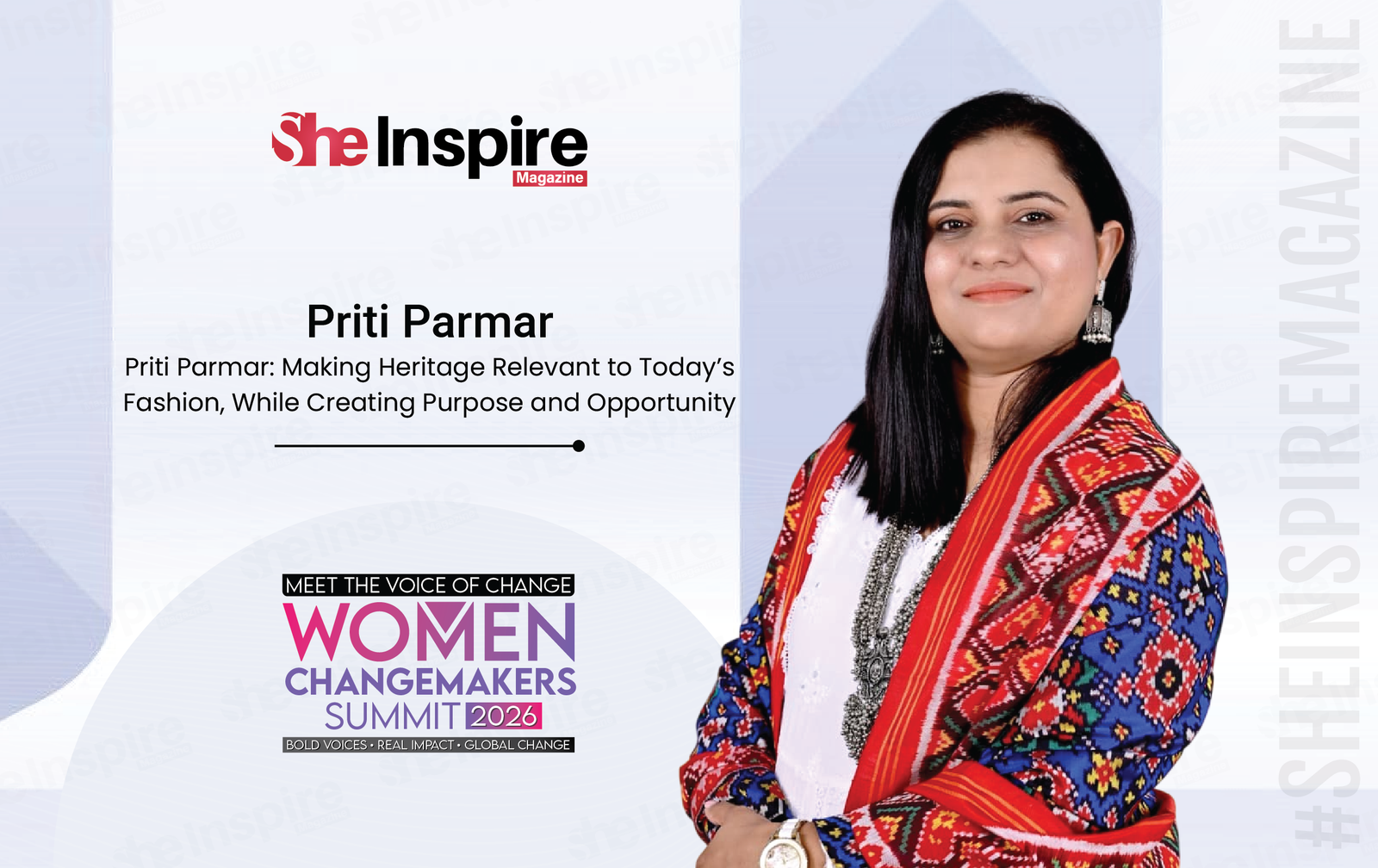
Priti Parmar: Making Heritage Relevant to Today’s Fashion, While Creating Purpose and Opportunity
Some traditions survive because they are carefully preserved. Others survive because people continue to wear them, use them and find new ways to make them relevant to their lives.
For Priti Parmar, founder ofVirasat Patola, Patola belongs to the second category.
Patola has been part of Priti Parmar's family for more than four decades. So for her, it is not just a textile or a business—it is something she has known closely over the years. With Virasat Patola, she is now finding new ways to present this traditional craft to today's audience, from contemporary styling and exhibitions to conversations with women working in fashion, textiles and handloom.
For her, it is about more than building a business. It is about keeping a part of Gujarat’s heritage alive, taking it to new audiences, and creating opportunities for the people and communities connected to this craft.
Promoting the Heritage of Gujarat
Patola is one of Gujarat’s most recognised traditional crafts. Every saree carries hours of work, skilled craftsmanship and techniques that have been passed down from one generation to the next.
Priti wants to bring that story to more people.
Through Virasat Patola, she shares authentic handwoven Patola while also talking about the colours, motifs, traditions and occasions that make the craft such an important part of Gujarat’s culture.
But she also believes that heritage should not feel distant or difficult to understand.
A younger generation may appreciate a Patola differently from the generation before it. They may want to style it differently, wear it at different occasions or combine it with contemporary jewellery and fashion. Priti sees this as an opportunity rather than a challenge.
Bringing Today's Fashion to Heritage
One of Priti's biggest interests is finding the connection between traditional Patola and today's fashion.
Patola has traditionally been associated with weddings, festivals and important family occasions. Priti wants to show that Patola doesn’t have to remain limited to traditional occasions.
It can be styled in new ways, paired with contemporary jewellery, turned into accessories, or even chosen as a meaningful cultural gift.
The idea is simple as Priti says: “tradition does not have to compete with fashion. It can be part of it.”
For Priti, keeping the craft relevant does not mean changing what makes Patola authentic. It means finding new ways for people to connect with it.
A Woman Entrepreneur in a Traditionally Male-Dominated Industry
Building a business around a traditional craft has its own challenges. Priti has also had to find her place as a woman entrepreneur in an industry where business and trade have traditionally had strong male representation.
She has approached it by building her own voice and staying close to what she believes in.
Her work brings together different sides of entrepreneurship—business, fashion, digital marketing, storytelling, customer relationships and community building.
She also wants her journey to encourage other women to see entrepreneurship as an option, including women who may be connected to traditional crafts and family businesses.
Creating Livelihoods and Meaningful Impact
For Priti, the people behind the craft matter as much as the product itself.
Patola cannot exist without the weavers and artisans who carry the knowledge of the craft forward. Staying connected with the weaving community is therefore an important part of her work.
She believes that traditional crafts can survive only when the people practising them have a reason and an opportunity to continue.
This is where business and purpose come together for her.
A successful heritage business can create demand for traditional skills, support livelihoods and give younger generations a reason to stay connected with crafts that might otherwise slowly disappear.
Priti also wants to create more opportunities for women to work, participate and build their own livelihoods. For her, empowerment is not only about talking about women in business. It is also about creating spaces where women can actually contribute and grow.
Connecting with the Weaver Community
Priti's relationship with the weaving community goes beyond sourcing a product.
She wants customers to understand the work behind the Patola they purchase. The colours, motifs and patterns may catch someone's eye, but there is a much longer story behind each piece.
That story includes the artisan, the weaving process and the knowledge that has travelled from one generation to another.
By keeping that connection alive, Priti hopes to bring the customer closer to the craft and the craft closer to the customer.
Starting Conversations Around Women, Fashion and Heritage
Priti's work has also moved into the world of content and thought leadership.
Through her Virasat Conversations YouTube series, she speaks with women entrepreneurs, designers, stylists and others working around sarees, textiles, handloom and Indian fashion.
The conversations are not limited to products.
They cover entrepreneurship, changing fashion preferences, styling, traditional crafts and the experiences of women building businesses of their own.
This is an important part of Priti's journey. She is not only telling the story of Virasat Patola; she is giving other women a platform to tell their stories too.
These conversations allow viewers to hear directly from women who are building businesses in traditional and creative industries. They also open up conversations around how Indian textiles and crafts can stay relevant in a changing market.
Taking Gujarat to a Global Audience
Virasat Patola has customers not just in India but across international markets as well.
The brand offers global delivery, allowing customers outside India to connect with Patola and, in their own way, with a part of Gujarat's cultural heritage.
For Priti, this is about more than selling overseas. It is about taking something made in India to the world while keeping its roots firmly here.
It is a small but meaningful part of the larger Make in India story—Indian craftsmanship finding its way into homes around the world.
Meeting Customers Beyond the Store
Priti also actively participates in exhibitions and events where she can meet customers face to face.
Platforms such as Bharat TEX, along with wedding and bridal exhibitions, give Virasat Patola an opportunity to reach new audiences and understand how people are thinking about traditional textiles today.
These events also allow Priti to show how Patola can fit into modern weddings, celebrations, gifting and fashion.
For her, meeting customers in person is just as important as building an online presence. These conversations help her understand what people are looking for, answer their questions and, most importantly, share the story behind the craft.
Keeping Heritage Relevant
Priti Parmar's journey is a reminder that preserving heritage does not always mean looking backwards.
Sometimes, it means finding new reasons for people to look at it again.
Through Virasat Patola, Priti is working at that intersection of heritage, fashion, entrepreneurship and purpose. She wants to do more than just sell Patola. She wants to stay close to the people who make it, create more opportunities around the craft and help more people see how Patola can fit into their lives today.
For Priti, the goal is to see Patola being worn, gifted and celebrated—not just kept as something from the past, but passed on to the next generation.
She believes that if people continue to use and enjoy something, the tradition behind it has a better chance of living on.