More Than Marks: The Woman Who Chose to Teach Children How to Live
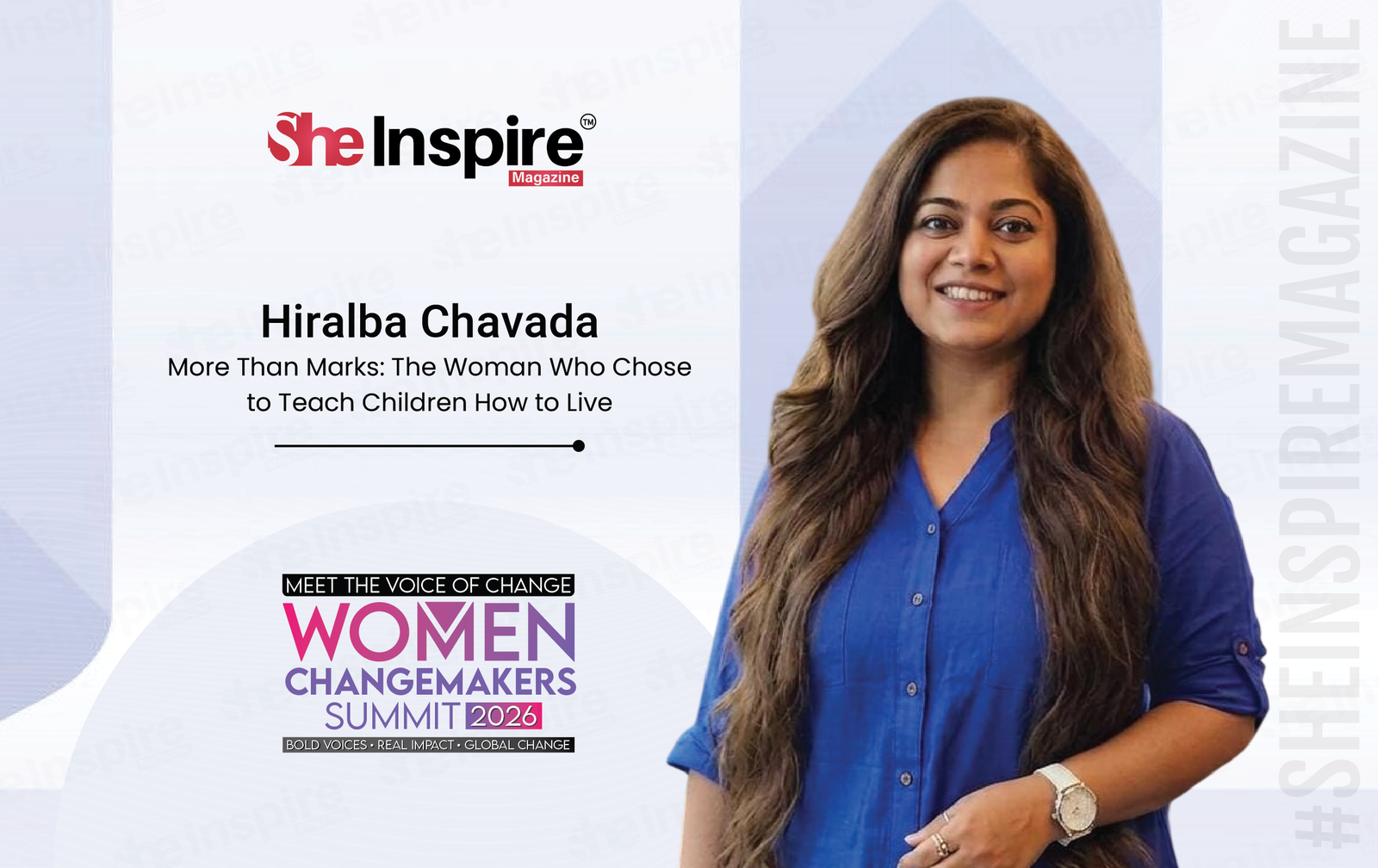
Before the term holistic education became a common phrase, Mrs. Hiralba Chavada posed a question:
What if the purpose of education was not solely to produce successful students, but good human beings?
It Started With a Question
Some journeys begin with a vision or a business plan. Others begin with an opportunity.
Mrs. Hiralba Chavada’s journey in education began with a question.
Can education be something different?
When she launched Mayurhirs in 2009, she wanted to reimagine the traditional idea of education. In her vision, had to be more than textbooks, examinaexaminations,ades.
She wanted children to learn how to think, communicate, understand their emotions, face challenges and, most importantly, become better human beings.
That vision gave rise to Mayurhirs Achievers.
What began as a belief grew to an educational journey covering preschool and daycare centres, primary schools and teacher-training initiatives. Yet, throughout that journey, one thought remained at the core:
The child must never lose track of the marks.
When a Report Card Cannot Tell the Whole Story
A number can tell us how a child performed in an examination.
It cannot tell us how kind that child is.
It cannot tell us if they helped a classmate, overcome a fear, found the courage to speak, learned from a mistake or discovered something they genuinely love.
For Mrs. Chavada, that distinction matters.
Her educational philosophy challenges the idea that grades can define a child.
“Don’t judge children only by grades. They have to become human beings.”
Academic achievement has its place, but it is only one part of growing up. Children also need confidence, empathy, communication, creativity, emotional awareness, independence, responsibility and humility.
These qualities may not appear on a report card.
They can, however, stay with a person long after the report card has been forgotten.
Children Were Never Meant to Be Robots
There is a difference between educating a child and programming one.
Mrs. Chavada believes that children should not simply remember, follow instructions and reproduce answers. They are naturally curious, question, experiment, make mistakes, imagine and feel.
“Children are not robots.”
That belief has influenced the educational thinking behind Mayurhirs, particularly its emphasis on social-emotional learning and life skills.
A child needs to know what to learn, but also how to handle disappointment, respect another person’s feelings, express an opinion, work with others and stand back up when something does not go their way.
After all, eventually, life stops giving marks.
What remains are the qualities a child carries within.
A Vision Ahead of Its Time
Today, ideas such as holistic development, social-emotional learning, experiential education and life skills are increasingly discussed in education.
For Mrs. Chavada, however, these were never simply fashionable terms. They were part of the vision from the beginning.
Her approach has always been looking beyond academic achievement towards the complete development of a child.
The educational philosophy at Mayurhirs also draws from PanchakoshaVikas and the Panchadi learning process of Adhiti, Bodh, Abhyas, Prayog and Prasar — encouraging children to understand, practise, apply and express what they learn.
The idea is simple:
Knowledge should not remain inside a notebook.
It should become something a child can use, experience, question and carry into the real-world.
The Teacher Who Sees What a Grade Cannot
But if children are the heart of education, teachers are the people who stand alongside them every day.
That is why Mrs. Chavada’s vision extends beyond students.
She believes teachers must be more than syllabus-completers. They must become observers, mentors, listeners and guides.
A teacher may be the first person to notice that a quiet child has an extraordinary imagination.
A teacher may be the one who says, “You can do this,” at the exact moment a child has stopped believing it themselves.
Sometimes, a teacher does not change a child’s marks: they change the way that child sees themselves.
That responsibility requires teachers to understand children — not simply teach them.
This belief led to the establishment of the Mayurhirs Teachers Training Institute in 2016, offering programmes in Nursery Teacher Training, Pre-Primary Teacher Training, Early Childhood Care and Education and Montessori education.
For Mrs. Chavada, empowering teachers is ultimately another way of empowering children.
The Challenge Was Bigger Than Building a School
Changing education is never as simple as changing a classroom.
Traditional expectations are deeply rooted. Parents worry about marks. Children compare themselves with one another. Schools are expected to produce measurable academic results.
Against this backdrop, looking beyond grades requires conviction.
Mrs. Chavada’s challenge was therefore not merely to build an institution, but to build a mindset.
To show that academic learning and life skills can exist together.
That discipline and creativity can co-exist.
That ambition does not have to come at the cost of empathy.
And that a child can strive for excellence without believing their marks determine their worth.
That balance has remained an important part of her journey.
Not Just for the Few
Another important part of her vision is that meaningful education should not feel like a privilege reserved for a select few.
Every child deserves good teachers, meaningful experiences and opportunities to discover what they are capable of.
The middle-class child, too, deserves exposure, encouragement and confidence-building experiences - not merely an education designed to help them pass an examination.
As Mayurhirs expanded across different locations, this belief remained part of the larger journey.
For Mrs. Chavada, educational progress becomes meaningful when it reaches children where they are and helps them see possibilities beyond what they may have imagined for themselves.
Sometimes education gives a child knowledge.
Sometimes it gives them confidence.
And sometimes it gives them the courage to imagine a different future.
The Woman Who Keeps Looking Forward
Visionary and ambitious are words associated with Mrs. Chavada’s leadership. But perhaps the question that best captures her approach is much simpler:
“What can be better for the child?”
It is a question without a final answer.
How can teachers become better?
How can classrooms become more meaningful?
What skills will children genuinely need in life?
How can education create achievers without losing sight of the human beings behind those achievements?
Her contributions have been recognised through honours including the Best Educational Franchisee Award 2025, Innovative Curriculum & Student Development Award 2024, Excellence in Education Leadership Award 2024 and Education Icon of the Year Award 2025,Official Representative of Pink Parliament& Women Changemaker of the year 2026 by She Inspires Magazine
Yet for an educator, recognition can take another form.
It may be the child who grows in confidence.
The teacher who discovers a better way to reach a student.
The student who learns that failure is not the end.
Or the young person who leaves school carrying values along with certificates.
What Should a Child Carry Forward?
Perhaps this is where Mrs. Chavada’s vision becomes bigger than education itself.
What should remain with a child after the school years are over?
Confidence without arrogance.
Success without losing humility.
Knowledge with empathy.
Ambition with humanity.
And perhaps most importantly, the understanding that their worth was never determined by a number on a page.
Years from now, grades may be forgotten. Textbooks will change. Classrooms will change.
But the confidence a teacher gave at the right moment can stay.
So can the kindness a child learned, the courage they developed and the values they carried into adulthood.
These are the lessons that do not end with the school bell.
That, perhaps, is what Mrs. Hiralba Chavada has been working towards since 2009.
Not an education that simply asks children to succeed.
An education that teaches them what to do with that success.
Because the greatest achievement of a school is not producing children who know all the answers.
It is helping raise humble, capable and compassionate human beings — people confident enough to find their own answers, grounded enough to keep learning and courageous enough to use what they know to make the world around them a little better.
More than marks.
More than achievements.
More than a report card.
An education that teaches children not only how to succeed in life -but how to live it.