From the Hills to the Lecture Hall
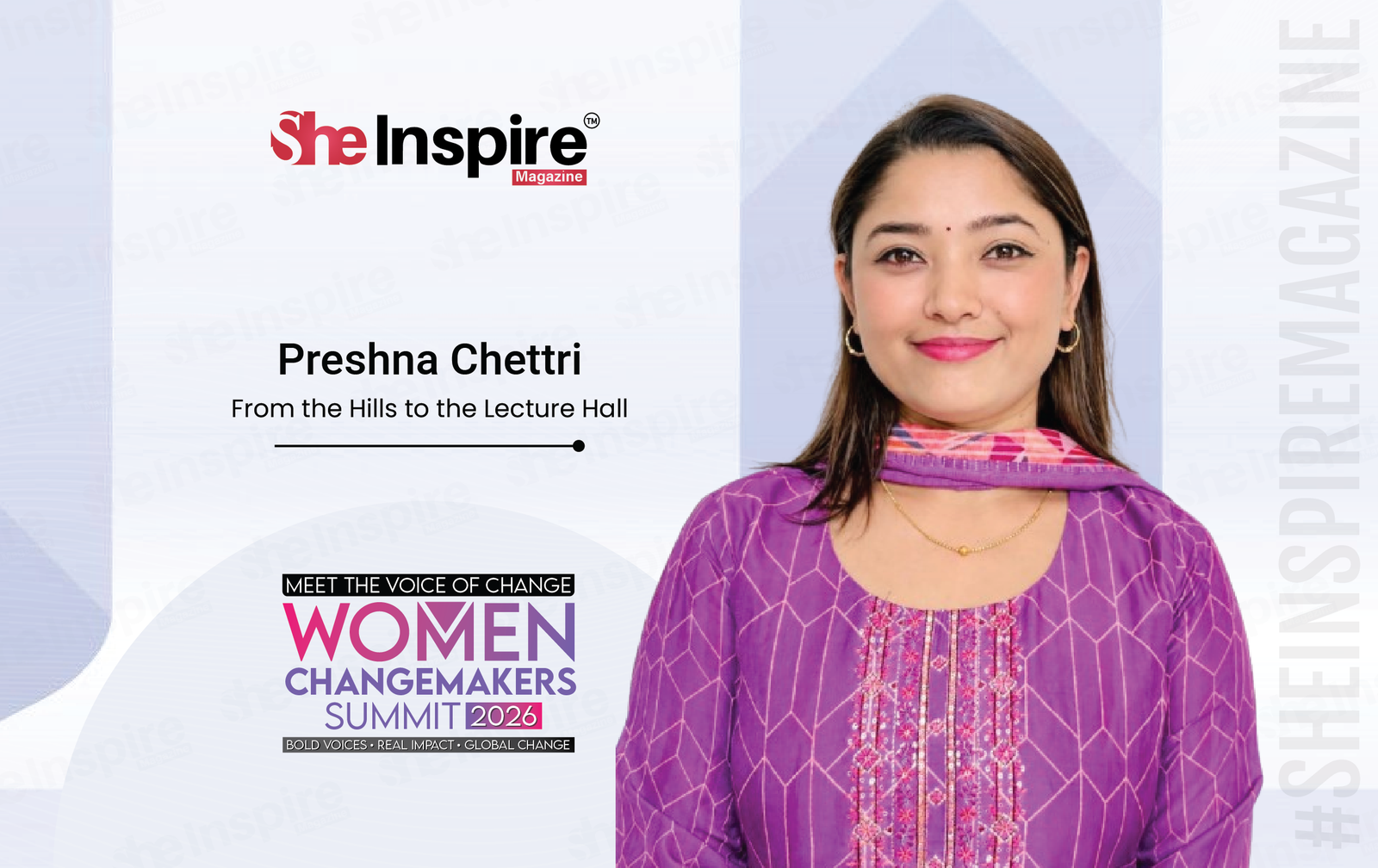
Preshna Chettri grew up in the hills of Darjeeling, in North Bengal. Her roots in the region's culture run deep. So does a respect for education she picked up early, along with a fair amount of stubbornness. She would need both, as it turned out.
That stubbornness has taken her a long way. Right now she lives in Chennai and studies full-time for a PhD in Nursing at Sri Ramachandra Institute of Higher Education and Research (SRIHER for short). This year she has spoken at conferences in Thailand and Malaysia. And she was named Young Changemaker of the Year at the Women Changemakers Summit 2026, South Zone.
None of it happened at once.
Learning the work
Her training started in nursing and kept widening. She qualified in General Nursing and Midwifery and went on to earn a BSc in Nursing and an MSc in Pediatric Nursing. Then she went back and did a Master's in Psychology too. Put together, her qualifications cover healthcare, education and human behavior, and she draws on all of them.
She also worked as a nursing instructor, and the job got under her skin. Every new batch pulled her in a little further. A good teacher turns out capable nurses. She wanted more than that from hers.
Ask her what education is for and books and exams barely come up. She says it ought to teach students to think critically and make good choices, and give them confidence and compassion along the way. It's a broad definition. Keep that in mind, because it led pretty much straight to her PhD.
The PhD
Her doctoral research at SRIHER looks at new ways of teaching nursing. Specifically, she is studying how gamification influences attitude, acceptance, learning experience and satisfaction among nursing students.
The interest comes from a simple observation: change is inevitable. Students change. Technology changes faster. A lecture that worked for one batch won't always land with the next lot, who grew up with phones in their hands. So she is trying out interactive, tech-based ways of teaching, to see whether students engage more when classes are built around them.
She doesn't treat research as a box to tick on the way to a degree. She went into it wanting answers. Where do nursing students switch off? Would a different approach keep them interested? And can she back it up with data?
Abroad and in print
The work has carried her well beyond the classroom. She represented India at the 12th World Conference on Women's Studies 2026 in Chiang Mai, Thailand, where she brought her interests in education, research and women's empowerment into a much wider conversation. She was also a session speaker at the World Conference on Women's Empowerment, Gender Equity and Social Impact 2026 in Kuala Lumpur, Malaysia.
She came back from both trips with an old hunch confirmed. One person with a good idea doesn't change much on their own, she says. You need a crowd, and the crowd has to listen.
Closer to home, she writes. She is a frequent contributor to the Himalayan Darpan, where her pieces deal with women's education, health, empowerment and social development. Much of that writing is about women in hill areas and other places that are cut off, whether by geography or by the way society treats them.
Her reasoning is practical: get people talking first. Once the information is out and the conversation has started, people are far better placed to make sense of a problem and look for a fix. Writing, for her, is how research and lived reality get to meet.
What she wants for others
Her ambitions reach past her own CV. She wants to inspire young women, especially those from rural and hill communities, to go after opportunities in education, research, leadership and the professions. She is firm that women should have the confidence and independence to set their own goals, rather than letting circumstance or other people's expectations set those goals for them.
She also believes in learning across disciplines. Nursing, psychology, education and research each see part of the picture. She'd know. She has had a foot in all four.
The Young Changemaker award was an encouraging moment. She doesn't treat it as a finish line. She sees it as a prompt to think about her responsibilities and to keep contributing through teaching, research and public engagement.
What's next? More work in nursing education, a stronger research record, and more openings for women and young professionals, if she has any say in it.
Her advice to young women is short. Never underestimate education, consistency or believing in yourself. Everyone moves at their own pace, she says, and real progress usually comes in small, deliberate steps.
There have been a lot of those steps since Darjeeling. Plenty more are coming.