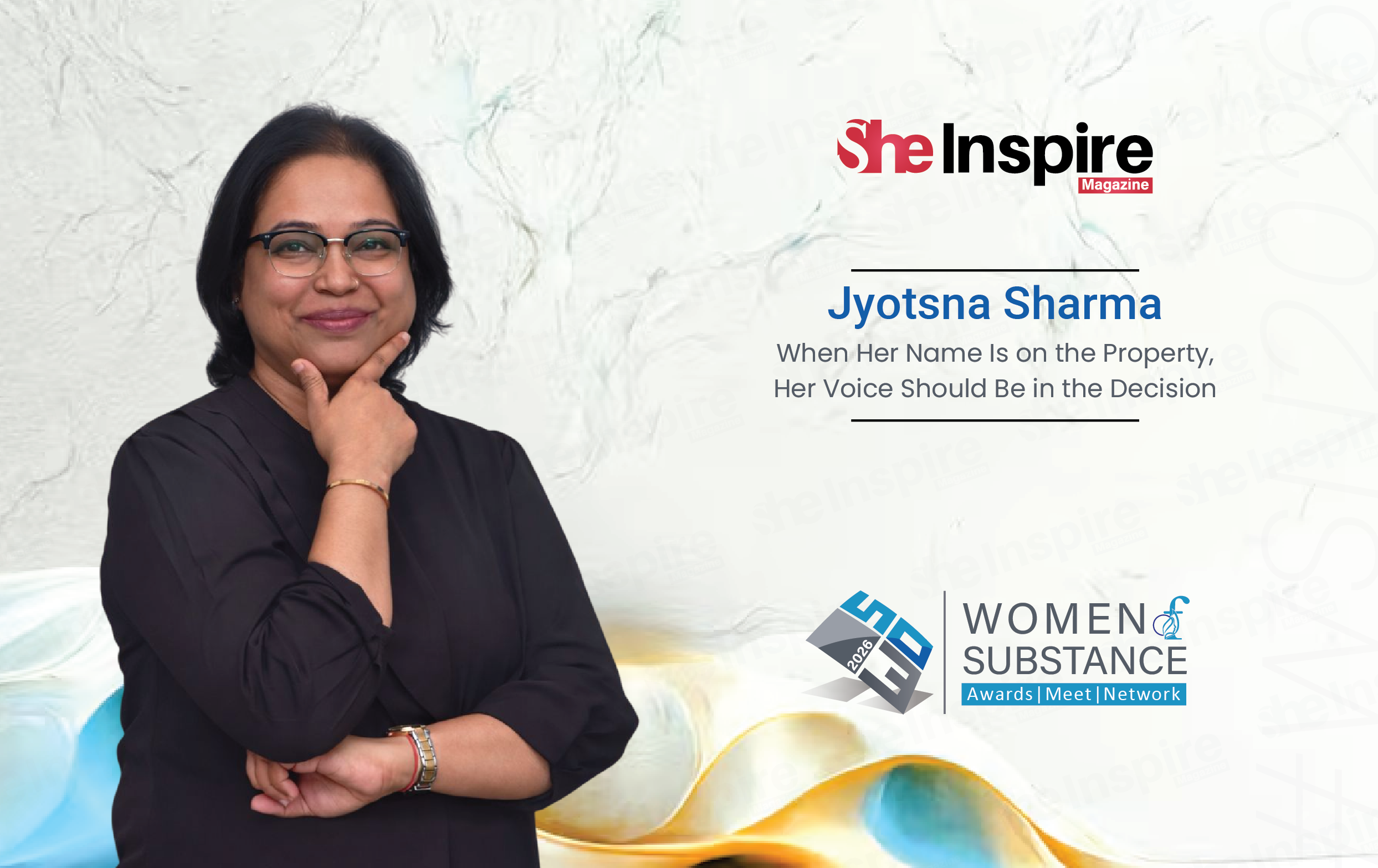
When Her Name Is on the Property, Her Voice Should Be in the Decision
Because identity deserves awareness, participation, and respect.
Real estate is often associated with numbers, return on investment, contracts, and paperwork. But for those who work closely with it, every property tells a human story. Behind each purchase of the property, be it residential or commercial, there are families, trust, emotions, money, and long-held dreams that are tied to a place that gives us a home to live or earn revenue to run that home.
When Jyotsna started her career in real estate, the industry was very different. It was largely unorganised. Processes were unclear, standards varied, and property buyers had little protection. There were no formal safeguards, such as RERA. People had to rely more on trust and had no governance to protect their costliest purchases.
Jyotsna’s perspective evolved over the period of time while handling thousands of customers in this journey.
From the Ground Up: A Journey of Perspective
Starting from a junior role and growing into a leadership position managing regions and teams, Jyotsna witnessed the industry’s transformation up close. She was seeing the human side of the industry instead of just the systems and scale of the business.
She saw that property, which is one amongst the triad of necessities, i.e., food, cloth, and home, was not just an individual dream but a collective one, shaped by family conversations, compromises, and hopes for the future.
In her mind, one thought remained constant: when a decision affects everyone, every voice matters.
The Gap Between Paper and Power
Over time, Jyotsna noticed something uncomfortable with. Women’s names were increasingly appearing on property documents, which looks like progress. But in reality, many women were involved only at the last step, signing papers without even being given any information that their names had been used to get the loan processed or to purchase a property of crores. And they also don’t even know about the consequences of any failures in the events if they happened. Their ownership existed on paper, but not always in practice.
This is where a critical gap appeared.
True ownership is not just about having your name on a document.
Legally, if a woman’s name is on the sale deed, she is the owner, regardless of who paid for the property. She has full rights and full responsibility. Ownership does not change based on who handled the negotiations or transferred the money.
At the same time, tax laws look separately at who funded the property and who benefits from its income. The government introduced incentives to encourage women’s ownership and empowerment. The intention was right.
But in many families, the outcome looked different. Properties were registered in a woman’s name for benefits, while decisions, control, and understanding remained elsewhere.
Please note: This story is not about interpreting tax laws. It is about awareness. About women being informed, involved, and heard when their name represents ownership, because with ownership comes responsibility, whether one realizes it or not.
From Signing to Ownership in Practice
As a leader, Jyotsna began changing how these moments looked. Signing a document was no longer a silent formality. It became a “signing ceremony”.
Women were encouraged to ask questions. To understand loans, obligations, and long-term impact. To know that signing without understanding is not trust, it is a risk.
Because when a woman’s name is on the property:
- Legal rights belong to her
- Financial liabilities return to her
- Tax responsibilities follow her
When she understands this, her signature is no longer symbolic. It becomes a statement of confidence and control.
As Jyotsna often says: “Equality is not about taking power from someone else. It is about respecting a woman’s voice when she is part of a decision.”
A Vision for Financial Freedom
Over the years, Jyotsna saw a pattern. Women were everywhere, managing homes, supporting families, signing documents, but often missing from real decisions.
Rich Mom Poor Mom started growing from these lived moments. It is not only about discussing money, but it is also about confidence, awareness, and participation in finances, choices, and life.
This is not a theory. It is experience. Jyotsna saw how small gaps in knowledge slowly became gaps in power, and how shared knowledge could change how a woman shows up at home, at work, and in her future.
Rich Mom Poor Mom is a thought space to start honest conversations where one can ask questions, enhance knowledge, and understand what financial awareness about investments, property and other assets and their ownership in real meaning. It is to encourage women to learn not just for themselves, but to share that knowledge with others, within families, friendships, and communities.
A Foundation for the Future
Jyotsna believes awareness is quiet power. She invites women to understand money and ownership, not to challenge others, but to stand firmly in the strength that is shared.
She also honours the many men who, even when they make payments for a home /property themselves, respect the women in their lives as Lakshmi, the soul of the home. That respect must show in every transaction.
If a woman’s name is on the deed, she belongs in the decision.
She hopes more women will join this conversation and carry it forward under one shared thought #RichMomPoorMom.