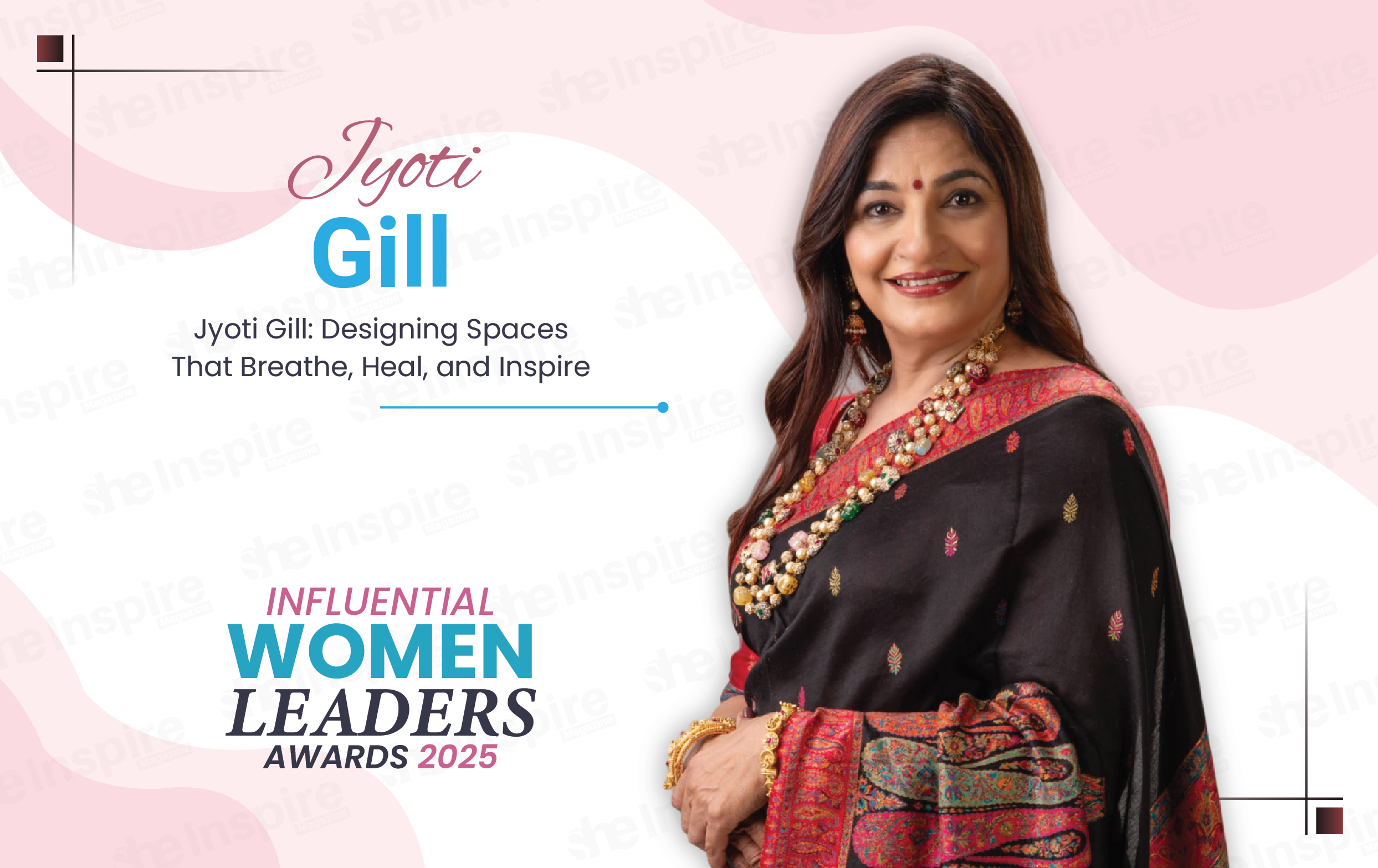
Jyoti Gill: Designing Spaces That Breathe, Heal, and Inspire
“You don’t have to raise your voice to make an impact. Sometimes, the quietest spaces are the most powerful.”
When space became a language
Jyoti Gill didn’t choose architecture. “It chose me,” she says with a quiet conviction. As a child, she would rearrange rooms, sketch in her notebooks, and wonder how sunlight could transform a wall into something alive. “I realized that space holds energy, and I wanted to shape it,” she recalls.
Architecture, for Jyoti, is not just form and function. It is what she calls “the alchemy of form, feeling, and future.” Over the years, this perspective evolved from intuition into a design philosophy that blends sustainable innovation, spiritual science, and human connection.
Learning from resilience and rootedness
Jyoti’s mother showed her that strength need not be loud. “Her quiet resilience taught me grace in grit,” Jyoti says. Professionally, the writings and work of Laurie Baker and B.V. Doshi guided her belief that buildings should serve life, not just aesthetics.
Her early career began in conventional practice — glass, steel, and deadlines. But a pivotal shift came when she began weaving ecological responsibility, cultural wisdom, and Vastu Shastra into her designs. Recognition from programs like Goldman Sachs 10,000 Women and The Real Women Award affirmed her vision of aligning design with impact.
Achievements that go beyond awards
Jyoti doesn’t measure success in trophies. “The true award is when a mother says her child sleeps better in a home we designed,” she explains. Still, her contributions are far from unnoticed: she has earned commendations from national green building councils, women-in-business forums, and architectural institutions for integrating sacred geometry and high-performance standards in institutional projects.
Her consultancy has delivered designs that merge Vedic architecture with cutting-edge sustainability, influencing both urban layouts and individual buildings. Equally important to her is mentorship — guiding young professionals, especially women, to see design as a responsibility, not just a career.
The hardest battles: tradition, innovation, and perception
Convincing clients — and sometimes even herself — that intuition and intelligence can co-exist has been a defining challenge. “Walking the line between tradition and modernity is not easy,” she admits.
As a woman on construction sites, she was often mistaken for an assistant rather than the lead architect. “I’ve switched from site boots to school lunch boxes in the same hour,” she laughs, though the reality behind it was anything but light. Balancing stakeholder negotiations, technical deadlines, and family responsibilities required what she calls “integration, not separation.”
Values that anchor every design
Jyoti’s work is guided by principles that go deeper than trends:
-
Integrity in design:Decisions must serve both people and planet.
-
Cultural continuity:Buildings should honor memory while staying relevant to the future.
-
Ecological responsibility:Sustainability is a starting point, not an afterthought.
-
Empathy as leadership:Teams thrive when leaders listen before they direct.
-
Spiritual awareness:The built environment shapes human consciousness.
These values form her compass — ensuring that every project is both meaningful and measurable in its impact.
What keeps her moving forward
“Every building we create has the power to heal or harm — emotionally, ecologically, and culturally,” Jyoti says. This belief keeps her pushing forward, even on difficult days. She sees architecture as an ethical act, one where every decision leaves a trace on the lives of those who live, work, and dream in the spaces she builds.
Her motivation also comes from a deeper sense of purpose: “Women design differently. We bring intuition and intention together. What we build — in families, careers, or communities — can outlast us.”
Finding flow between work and life
When asked about balance, Jyoti resists the idea of strict compartments. “Balance isn’t static — it’s a dance,” she says. Some days involve answering site calls during school pickups; other days, her child sits beside her as she sketches late into the night. “You don’t have to do it all at once — but you must do it with presence,” she reflects.
Current initiatives and a vision for the future
Today, Jyoti is working on institutional and government projects that integrate astro-urban planning, Vastu-based zoning, and net-positive building strategies. Her team is also developing educational tools to help young designers embed spiritual and ecological intelligence in modern planning.
Her long-term goal? To establish a design research lab where ancient wisdom meets cutting-edge sustainability — and to mentor over 1,000 women in architecture and urban planning. She also dreams of designing a global women’s leadership retreat center that embodies energy healing, dialogue, and inclusive design.
Advice for the next generation
“You don’t need to choose between being strong and being sensitive,” Jyoti says. “Architecture needs both. Believe that your intuition is a skill. Your vision is valid. Leadership isn’t about loudness — it’s about presence.”
Her favorite words to share with young professionals echo this belief:
“Design is not a service, it’s a responsibility — to memory, meaning, and the future.”
And perhaps her quietest yet most powerful advice:
“You don’t have to raise your voice to make an impact. Sometimes, the quietest spaces are the most powerful.”