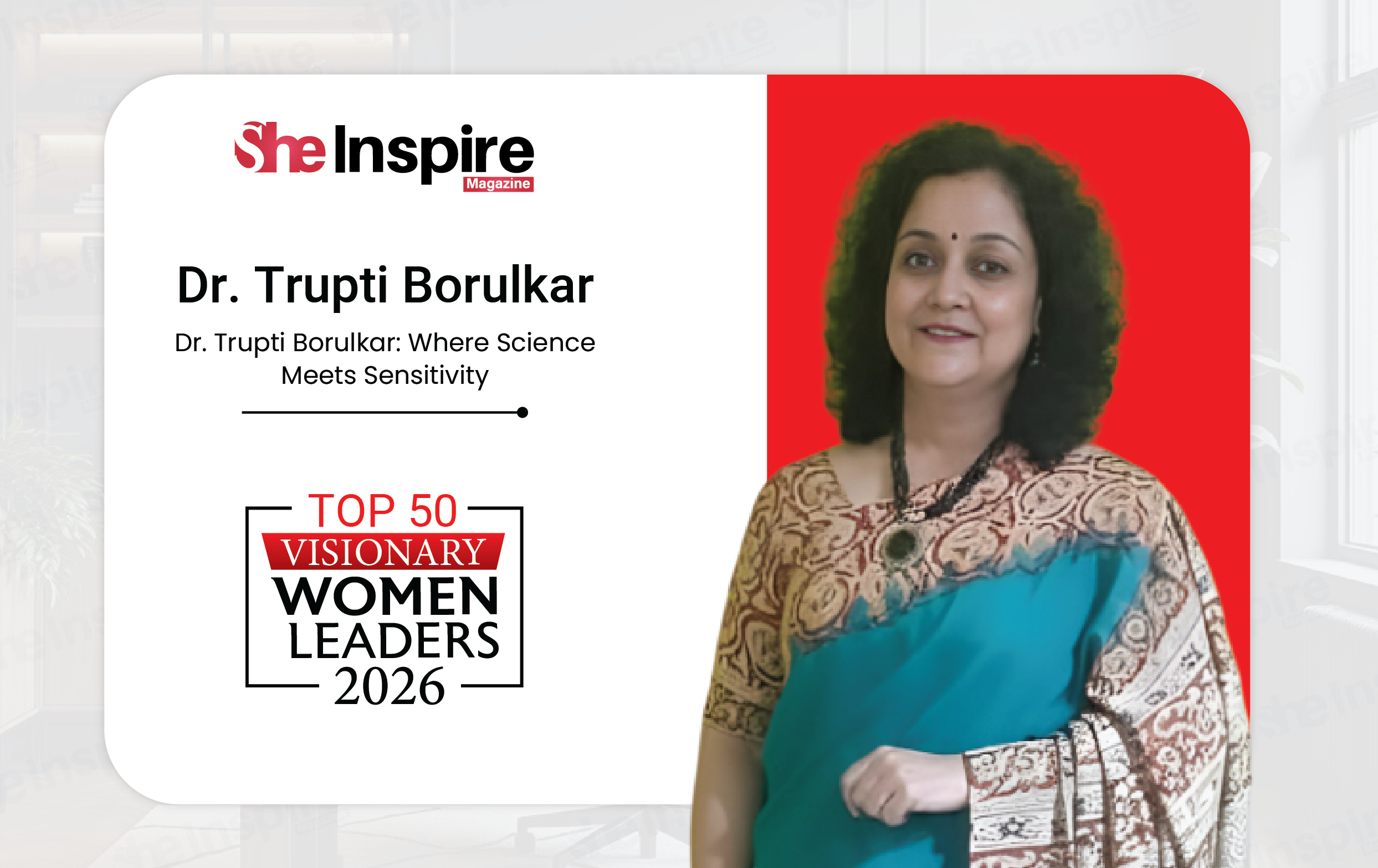
Dr. Trupti Borulkar: Where Science Meets Sensitivity
“Competence gives you the ability to treat; compassion gives you the ability to heal.” – Dr. Trupti Borulkar
In the silent confidence of her presence, one senses both clarity and warmth the rare equilibrium of science and sensitivity. Dr. Trupti Borulkar, is an Associate Professor in Physiology at Symbiosis Medical College for Women, Pune, and an experienced pediatrician with over 27 years in medicine, classifies a form of leadership that does not raise its voice, yet deeply influences generations.
Her journey through medicine has not been a straight professional ascent. It has been a thoughtful expansion of purpose one that connects clinic, classroom, and community.
Roots of Reflection: Where It All Began
Dr. Trupti grew up in a maternal family steeped in teaching, literature, social work, and the arts. Conversations at home were never shallow. They revolved around books, creative ideas, education, and the dignity of service. Teaching was not simply a career option; it was a calling.
That environment moulded her long before medical textbooks ever did. Building intellectual curiosity were not learned in medical school they were inherited, As she grew she learned that every individual holds a story and that listening is often as strong as diagnosing.
Years later, in paediatric wards, as she cured anxious parents and comforted scared children, she realized that medicine is as much about presence as it is about prescriptions. Those early years as a paediatrician taught her patience, care, and responsibility lessons that remain central to her personality.
From Healing Children to Shaping Doctors
Somewhere along the way, her role began to grow while interacting with medical students awakened the same nurturing instinct she felt with her young patients. She realised that future doctors more than clinical expertise needed mentorship, values, and emotional intelligence.
As she says,“My journey has been an evolution from healing children as a paediatrician to nurturing future doctors as a physiologist and medical educationist,”.
Today, as a educator, she works to strengthen academic systems and transform curriculum. She believes that while clinical care changes one life at a time, education shapes generations. The ripple effect of well-trained, compassionate doctors keeps her motivated, even when institutional reform demands patience and consistency.
Aarohan: Integrating Science and the Humanities
Moving ahead Dr. Trupti is also the founder of Aarohan, an initiative rooted in her belief that medicine must balance competence with conscience. Through this platform, she integrates health humanities with medical science ensuring that future doctors are not only clinically skilled but emotionally aware.
She has authored eight medical books along with creative works including storybooks and poetry. This reflects her work extends beyond hospitals and lecture halls. As a speaker and mentor, she engages with audiences on parenting, mental health, youth development, and teacher training.
And at heart, she is also an artist. Painting allows her to pause and process what words sometimes cannot express.
For her, these are not individual identities. They are interconnected expressions of one belief: that science, art, and empathy must coexist.
Depth Over Speed
We live in a world that often glorifies speed and visibility, Dr. Trupti advocates something different.
She advises young professionals “Do not chase speed chase depth,” “Depth of knowledge, depth of character, and depth of empathy still matter.”
She truly believes in dedication, not burnout. Medicine has traditionally celebrated exhaustion, but she questions that culture. A burnt-out doctor cannot be a compassionate one. Balance, she insists, is wisdom not weakness.
Redefining Success and Empowerment
To her, success is simple yet powerful: impact with integrity.
“If I can sleep peacefully knowing I worked ethically and made a difference, that is success.”
She also challenges the stereotype that women must choose between professional excellence and personal accomplishments. Today, Women can lead institutions, innovate in academia, nurture families, and remain emotionally strong not by dividing themselves, but by regulating their roles.
Empowerment, in her words, is precision and confidence in one’s voice. It is the freedom to think independently, act ethically, and create meaningful impact without apology.
Dr. Trupti Borulkar’s journey is not loud. It is layered and structured.
From the child in the clinic to the student in the classroom, her work is guided by the same steady thread care.
And perhaps that is her greatest contribution: reminding us that true leadership in medicine is not measured only in cures, but in conscience.