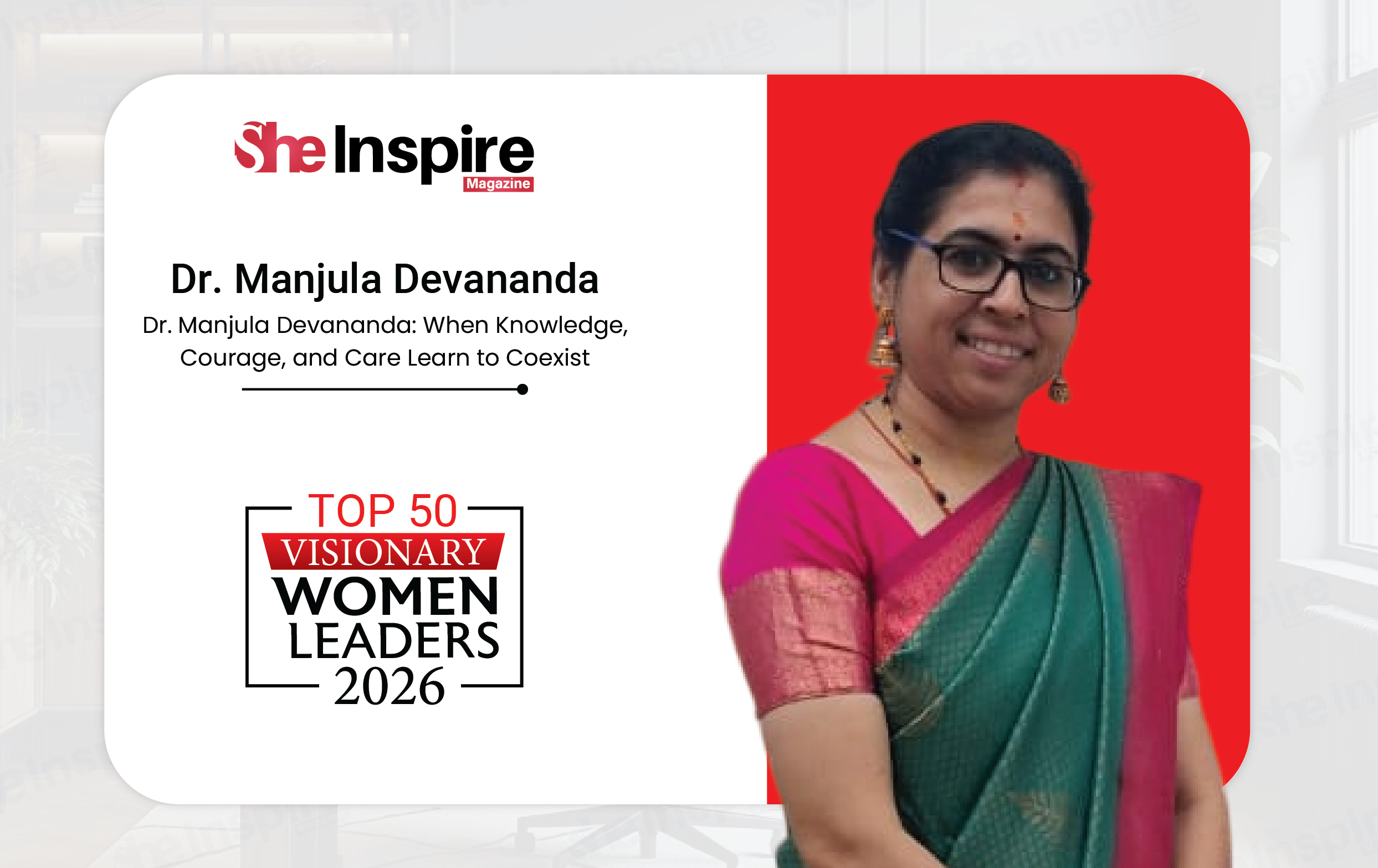
Dr. Manjula Devananda: When Knowledge, Courage, and Care Learn to Coexist
“Progress does not always require speed; sometimes it requires alignment.”
Dr. Manjula Devananda’s journey cannot be compressed into milestones or titles. Instead, it manifests through subtle choices, persistent bravery, and a steadfast determination to transcend limitations imposed by external factors. Presently an Associate Professor in the Department of Computer Science (AI & ML) at PES University, Bengaluru, she possesses over sixteen years of experience encompassing academia, research, institutional leadership, and community engagement. However, beyond her qualifications and titles, a more profound element exists experiential knowledge cultivated through resilience, introspection, and compassion.
Discovering Her Voice in the Face of Anticipated Silence
She was married at the age of twenty-one, even before completing her graduation.
Ironically, marriage became the first space where her voice truly mattered. Her mother-in-law—an educated woman who herself had been denied professional freedom—chose a different legacy. Conversations were held openly, opinions were respected, and financial independence was viewed not as a privilege, but a necessity. That belief reshaped Dr. Manjula’s path.
Soon after, she received a fellowship that took her to Canada for her thesis where she pursued her Master’s degree as a residential program, graduating as a First Rank Holder with a Gold Medal.
Ambition, Motherhood, and the Weight of Choice
Life did not move gently. Health challenges, delayed motherhood, and diabetes tested her resolve. When she received a fully funded PhD offer from New Zealand, her son was not even a year old. The choice was brutal academic ambition on one side, motherhood on the other.
What followed was an uncommon model of partnership. Her husband stepped into the role of primary caregiver while she attended university. Later, when physical separation felt unbearable and she considered abandoning the doctorate, it was her mother-in-law who intervened once more. She reminded her that independence earned today prevents regret tomorrow.
Dr. Manjula returned to New Zealand. She completed her PhD not without pain, but without resentment. The chapter fundamentally altered her perception of fortitude, reframing it not as the absence of feeling, but as the act of persevering in the face of it.
Art, rather than a means of evasion, became a refuge. During these periods of change, dance and music transcended their roles as mere artistic endeavors, evolving into vital sources of stability. Bharatanatyam and Carnatic music provided a means of confronting suffering without suppressing it. Subsequently, she began composing Carnatic music in Konkani and choreographing Bharatanatyam pieces that drew upon Konkani traditions, thereby safeguarding cultural heritage while simultaneously reinterpreting its manifestation.
In December 2024, she became a Guinness World Record holder for participating in the largest Bharatanatyam dance performance—an achievement that symbolised collective discipline and cultural continuity rather than personal spectacle.
Leadership as Responsibility, Not Control
A subsequent research opportunity brought her back to New Zealand, followed by an unforgettable return journey during the early days of COVID-19. Airports filled with fear stripped humanity down to its core. Borders blurred, hierarchies dissolved, and survival became the great equaliser. That journey changed her forever.
Back in India, her leadership expanded rapidly. From academia, she stepped into institutional responsibility, accepting the role of Principal at an engineering college in need of complete restructuring. Accreditation processes, regulatory frameworks, curriculum reforms she navigated it all, learning that leadership is not about authority, but accountability.
Parallelly, she founded Rimjhim, a not-for-profit initiative offering inclusive, activity-based learning for children who struggled within conventional systems. She also serves as Vice-President of GYRA (Global Young Researchers’ Academy), nurturing scientific thinking among middle-school students a conscious way of giving back to society.
Her commitment to culture led her to establish Dhondhon Chirapotul, an e-magazine dedicated to preserving GSB Konkani folklore and collective memory. Each initiative reflected the same belief: knowledge must circulate, not concentrate.
Redefining Success, Redefining Empowerment
For Dr. Manjula, success is not a destination it is becoming a better version of oneself. Empowerment, she believes, is not merely about finding one’s voice, but amplifying the voices of others. And equality, in her words, does not demand sameness.
“Difference is not hierarchy,” she reflects. “What matters is equal access to opportunity, choice, and dignity.”
Her journey is not linear. It is layered shaped by loss, strengthened by women who chose to uplift rather than limit, and sustained by the belief that alignment matters more than speed.
And perhaps that is her quiet lesson to the world: you don’t need to rush to arrive. You only need to stay true while becoming.