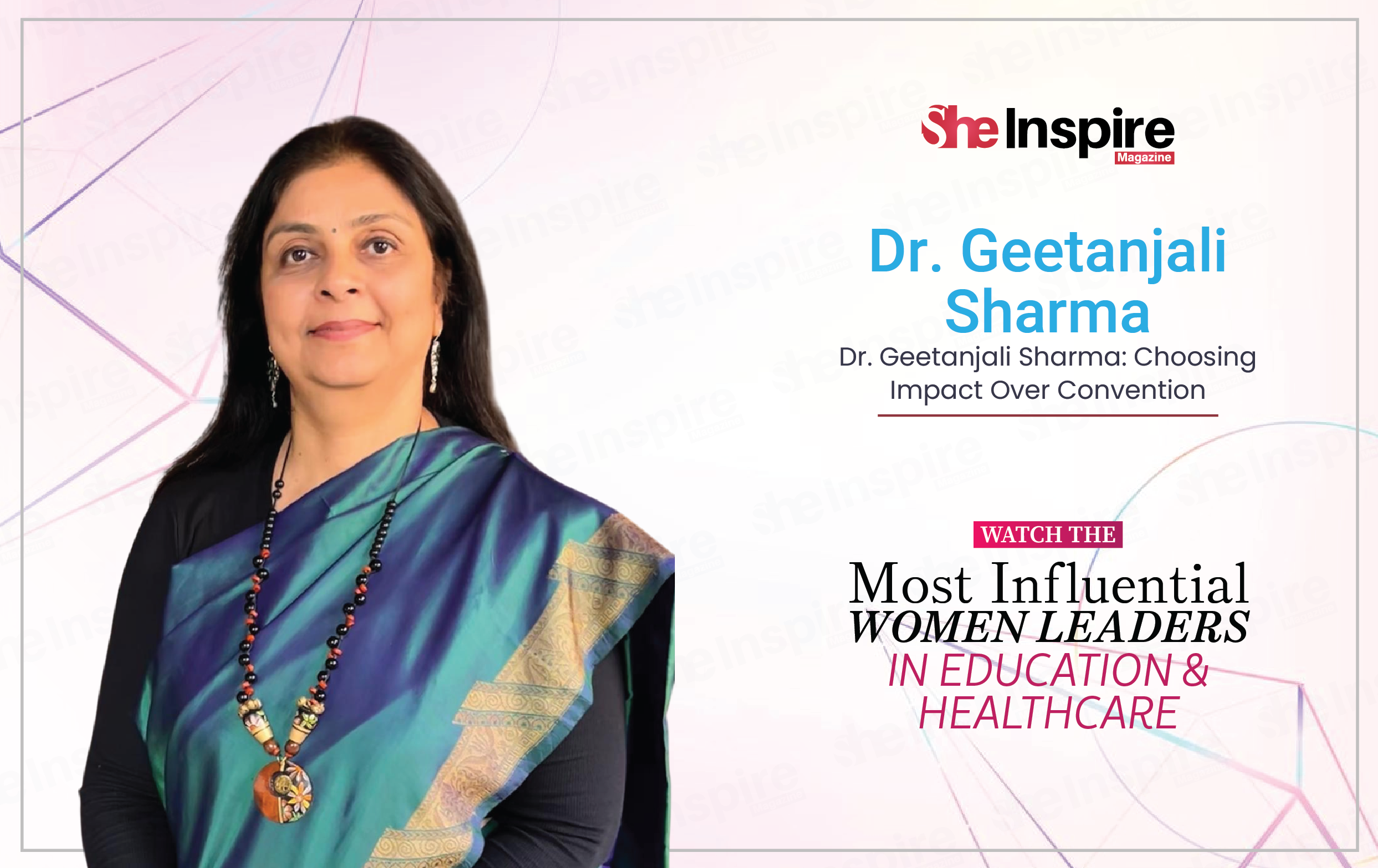
Dr. Geetanjali Sharma: Choosing Impact Over Convention
“Women are the largest untapped reservoir of talent in the world.”
For over two decades, Dr. Geetanjali Sharma has worked quietly yet decisively in spaces where health policy, science, and people’s lives intersect. A Public Health Expert and independent consultant with more than 20 years of experience, she has contributed to some of India’s most critical communicable disease control programmes, including Polio, Tuberculosis, and HIV. While many doctors find fulfilment in individual patient care, Dr. Sharma chose a path that allowed her to influence systems, policies, and populations often away from the spotlight, but always close to real impact.
“What drew me to public health,” she explains, “was the scale of change it allows. You may not always see the individual face, but you know your work touches millions.”
Personal Insight: Seeing Health Beyond the Clinic
Dr. Sharma’s decision to pursue Community Medicine was not the expected one. As a first-generation doctor from her parental family and surrounded by clinicians in her marital family, she was encouraged to follow a traditional clinical route.
Her early career took a defining turn when she cleared multiple competitive interviews and joined the World Health Organization as a Public Health Consultant with the Tuberculosis Control Programme. Posted in Haryana, she was responsible for providing technical oversight across eleven districts. This meant extensive field travel district hospitals, primary health centres, and remote villages where theory was tested daily against ground realities.
Those years shaped her leadership deeply. “Working alongside frontline health workers teaches you humility,” she reflects. “Policies only succeed when they acknowledge what happens at the last mile.”
Role Models Found in Authority—and Everyday Life
While moving forward she draws her inspiration from deeply human circle of role models, Her grandmother was one of her earliest role models her confidence, in spite of not being educated or financially independent inspired her during early childhood days. She was bold enough to travel alone with loads of goodies, loved going out with her friends to movies and made her own decisions in the era when women were neither the decision makers nor supposed to have a life of their own “
Another lasting influence has been her postgraduate guide, Dr. Pragati Chhabra, whose patient mentorship and motherly guidance built both professional confidence and emotional resilience during her training years.
Perhaps most striking is the admiration she holds for her domestic help of over seventeen years a woman who stood by her during both professional milestones and personal crises. “Wisdom doesn’t come with degrees,” Dr. Sharma says. “Sometimes it comes from lived experience, empathy, and quiet strength.”
Navigating High-Pressure Governance and Motherhood
Her move to Nirman Bhawan as a WHO Technical Consultant placed her at the heart of national health governance.
As a mother of two young children, she constantly balanced duty and instinct. There were days when her infant daughter waited with her grandmother in the ministry parking lot, and others when international conferences had to be declined because a child was unwell.
These moments prompted deep reflection. This understanding led her to transition into a long-term consulting role with the Global Fund, where she has worked for over eleven years supporting national TB, HIV, and malaria programmes.
Achievements Rooted in Accountability
Expressing with utmost joy about her achievement, While she doesn’t count her work as Technical Auditor and Public Health Expert for both governmental and NGO partners. How these roles has been involved in designing, reviewing and looking after large scale grants while ensuring that soundness aligns with budgetary discipline and measurable outcomes.
One of her early professional challenges came when she was entrusted with reviewing and approving multi-million-dollar programme budgets, despite having no formal financial training. “The responsibility was terrifying at first,” she admits. “But it taught me how deeply finance and public health outcomes are connected.”
That learning curve became a defining strength allowing her to bridge medical insight with fiscal responsibility.
Motivation Drawn from Working Women Everywhere
What motivates Dr. Sharma most is not hierarchy or designation, but purpose. She finds inspiration in women across professions doctors, bureaucrats, domestic workers, salon professionals anyone engaged meaningfully in their work.
She firmly believes that financial independence is central to a woman’s voice, dignity, and decision-making power. “When a woman earns,” she says, “she earns choices for herself and her family.”
Her own ability to balance career and life has been supported by a strong family network. Her mother left her teaching job to support her during early motherhood, while her husband encouraged her to pursue postgraduate education after marriage still uncommon in many households.
Impact, Vision, and a Life Still Unfolding
Currently, Dr. Sharma works closely with an international donor, coordinating with governments, NGOs, and multilateral agencies across India and Bangladesh. Her focus remains on Tuberculosis programmes reviewing grants, monitoring outcomes, and ensuring evidence-based implementation.
She leaves readers with a reminder borrowed from Hillary Clinton:
“Women are the largest untapped reservoir of talent in the world.”
Her advice to young women is clear and grounded:
Be educated. Be financially independent. Be confident enough to participate in decisions about your own life. Because when women lead with knowledge and agency, entire systems shift quietly—and permanently.