
Where Education Meets Media, Research, and Social Perspective
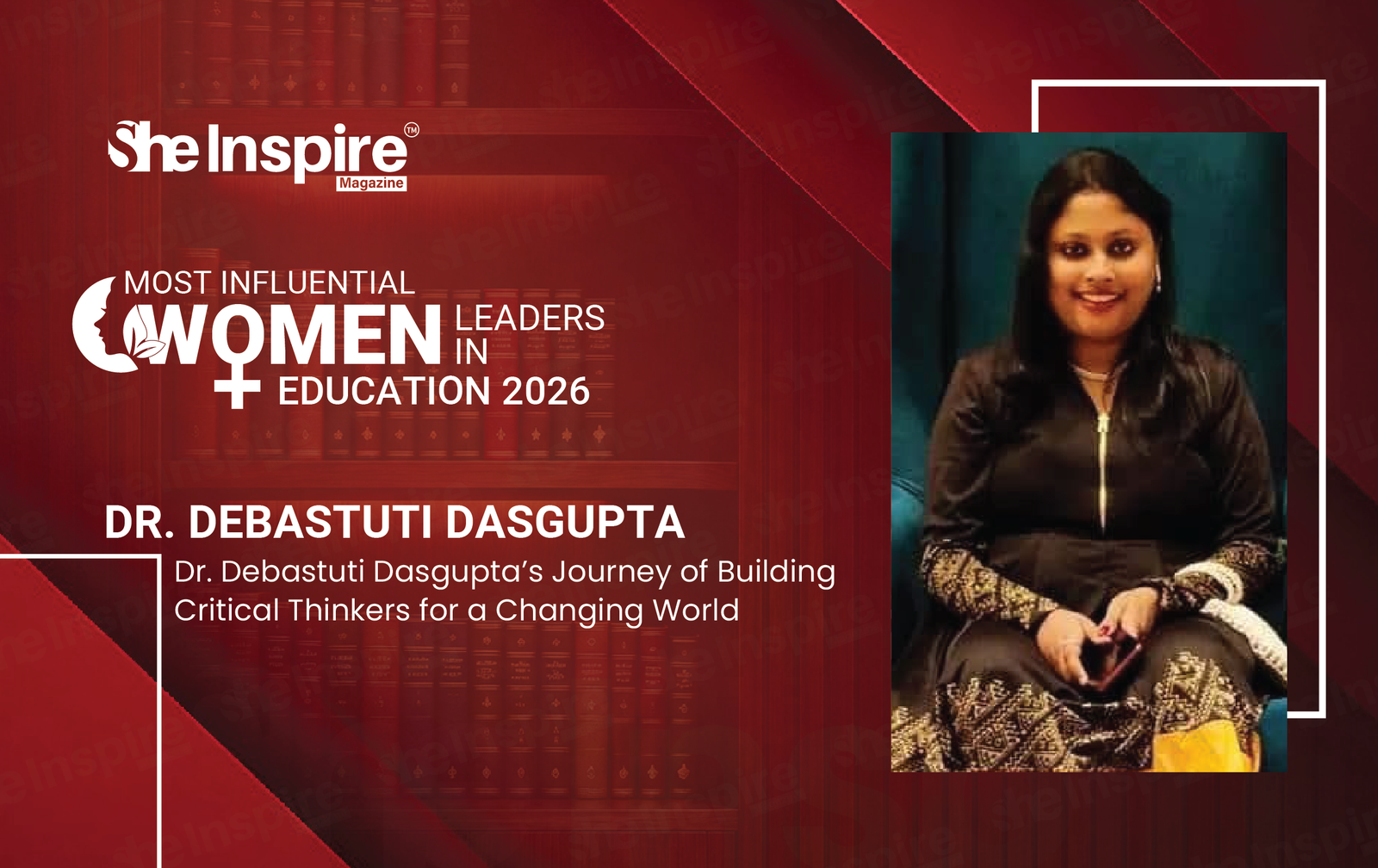
Dr. Debastuti Dasgupta’s Journey of Building Critical Thinkers for a Changing World
For Dr. Debastuti Dasgupta, the idea of becoming a teacher began long before she entered a college classroom.
It began with a child, a piece of chalk and a duster.
From her kindergarten days, teaching was something she imagined herself doing. She loved sharing knowledge and was fascinated by the ability of a teacher to communicate an idea, spark curiosity and influence the way another person sees the world.
Years later, that childhood instinct would become a professional calling.
Today, Dr. Dasgupta is an academician, researcher, author, media educator and mentor with 14 years of experience in higher education. As an Assistant Professor in the Department of Journalism and Mass Communication at Asutosh College, Kolkata, her work sits at an interesting intersection of media, education, research and society.
Her areas of expertise include Film Marketing, Audience Study, Gender and Media, but her larger academic purpose is broader: to help students understand not merely how media works, but how media shapes culture, democracy, public conversations and everyday life.
A Teacher’s Dream Takes Shape
Her years at St. Xavier’s College, Kolkata, played a defining role in shaping her understanding of education.
She remembers professors who were not only accomplished scholars but also exceptional communicators. Their passion, dedication and compassion left a lasting impression on her.
They showed her that a classroom should not be a place where knowledge is simply delivered.
It should be a place where students learn to think independently, question responsibly and grow in confidence.
That became the foundation of her own philosophy.
After completing her post-graduation, Dr. Dasgupta began her teaching journey with a part-time assignment at a Kolkata-based college. But her professional path did not remain confined to academics.
Alongside teaching, she became a Radio Anchor at Community Radio, Jadavpur University, where she spent six years engaging with communities and hosting educational programmes.
That experience introduced another dimension to her understanding of communication: its ability to create social change.
She subsequently worked as a freelance journalist with The Times of India, Kolkata Edition, for five years, reporting on socio-economic issues, education, culture and community stories.
Journalism took her beyond the classroom and into the realities people lived every day.
It taught her to listen carefully, observe closely, ask questions and understand different perspectives.
Those lessons would eventually become some of her most valuable tools as an educator.
From the Newsroom to the Classroom—and Beyond
A defining academic turning point came when Dr. Dasgupta qualified UGC-NET and enrolled for her PhD at Visva-Bharati University, Santiniketan, the university founded on Tagore’s vision of a universal center of learning.
The intellectual environment coupled with the assimilation of the East and the West of Visva-Bharati exposed her to scholars and researchers from different backgrounds and deepened her understanding of research methodology, academic inquiry and critical analysis.
The doctoral journey also taught her something that every researcher eventually learns: meaningful knowledge takes patience.
It demands perseverance, discipline and the willingness to keep asking questions even when the answers are not immediate.
When she joined Asutosh College, her understanding of teaching continued to evolve.
Teaching became less about delivering lectures and more about relationships.
Students arrived with different aspirations, different anxieties and different ways of understanding the world. Mentoring therefore became an essential part of her role.
She began supervising undergraduate dissertations, guiding research and encouraging students to communicate with confidence.
Over time, the teacher became a mentor—and the mentor evolved into an academic leader who sees compassion, curiosity and trust as essential ingredients of education.
Influence Is About Creating Possibilities
Dr. Dasgupta does not define leadership by position.
For her, being an influential woman leader in education means creating pathways where talent is recognised beyond gender and where people are given equal opportunities to learn, lead and succeed.
She believes education has the power to change mindsets.
That belief also informs her perspective on gender.
She wants young girls to dream without unnecessary limitations, while encouraging young boys to understand equality and respect. When women lead in classrooms, research, media, science or other professional spaces, they expand what the next generation believes is possible.
Her approach to leadership is rooted in integrity, inclusivity, empathy, innovation, collaboration and lifelong learning.
She encourages open communication and values environments where students feel comfortable asking questions and expressing ideas.
In an age where education can sometimes become overly focused on measurable outcomes, her philosophy brings the conversation back to something fundamental: the person behind the marks.
Bridging Theory with the Real World
One of Dr. Dasgupta’s most meaningful contributions has been her work in connecting academic learning with professional and social realities.
She has contributed to curriculum development, supervised undergraduate and postgraduate dissertations, published academic books and research articles, and promoted interdisciplinary learning.
Yet when asked about her most meaningful achievement, she points towards something more personal—the hundreds of students she has mentored who have gone on to careers in media, communication, research and academia.
Her goal has been to bridge theoretical knowledge with industry practice and encourage students to become socially conscious media professionals.
That approach is especially relevant in Journalism and Mass Communication, where students cannot afford to understand media only as a collection of theories.
They must understand people.
They must understand society.
They must understand power, culture, technology, representation and responsibility.
Dr. Dasgupta’s professional experience in teaching, radio and journalism gives her an unusual advantage in bringing these dimensions into academic conversations.
Preparing Students for an Age of AI
Dr. Dasgupta believes India’s education system needs to move beyond memorisation.
Critical thinking, creativity, interdisciplinary learning, ethical reasoning and problem-solving, she believes, must become central to education.
Students also need stronger exposure to research, digital literacy, AI, sustainability, communication and entrepreneurship.
Her own classroom practices reflect this thinking.
She integrates digital platforms, AI tools, media production, storytelling, research-based learning and collaborative classroom practices. She has encouraged project-based learning, community radio engagement, media workshops and interdisciplinary discussions that connect classroom concepts with contemporary societal issues.
But technology, in her view, must remain a means—not the purpose.
Her position on AI is particularly relevant for educators today.
As information becomes increasingly accessible, teachers cannot compete with machines simply by trying to provide more information. Their role must evolve towards mentorship, ethical guidance and critical thinking.
Students must learn not only how to use AI but also how to question it, evaluate it and understand its limitations.
Technology should enhance education.
It should never replace human values.
Research with a Social Conscience
Her academic initiatives include research supervision, academic writing workshops, human rights awareness programmes, media production activities and interdisciplinary research projects.
She also mentors students in academic publishing, dissertation writing, communication and career development.
This reflects an important dimension of her work: confidence-building.
A student may have a good idea but struggle to communicate it. Another may have the ability to research but lack the confidence to present the work. Another may understand theory but not know how to connect it to practice.
Mentorship becomes the bridge.
Dr. Dasgupta’s contribution to an open-access e-learning platform under the National Mission on Education through Information and Communication Technology further reflects her interest in making academic resources accessible.
She is also a Life Member of the Public Relations Society of India, Kolkata Chapter.
The People Behind the Journey
Her professional journey has been influenced by several important figures.
Her undergraduate teachers at St. Xavier’s College shaped her early understanding of academic excellence and communication. Her doctoral supervisor, Dr. Mausumi Bhattacharyya, Associate Professor, Centre for Journalism and Mass Communication, Visva-Bharati, played an important role in developing her research abilities and confidence as an academic professional.
Her father, Apurba Dasgupta, remains one of her strongest personal influences. His passion for academics and his dream of seeing her become an educator have remained an emotional source of motivation.
Her husband, Rajarshi, has also stood beside her through different phases of life with steady support and understanding.
For Dr. Dasgupta, balance comes from prioritisation, discipline and self-awareness—making space not only for professional responsibilities but also for family, reading, writing, research and reflection.
A Future Rooted in Knowledge and Humanity
Looking ahead, Dr. Dasgupta wants to expand research opportunities, encourage digital scholarship and strengthen collaborations between academia, industry and society.
Her vision for the next generation is an educational ecosystem that is inclusive, technology-enabled, research-oriented, emotionally supportive and globally connected—while remaining deeply rooted in Indian values.
That last part matters.
Because her vision of modern education is not one that abandons humanity in pursuit of technology.
It is one that uses technology while protecting empathy.
Her guiding belief captures the essence of her approach:
“Education should ignite curiosity, encourage compassion, and empower individuals to create positive change in society.”
For students, her message is equally clear: stay curious, stay ethical and never stop learning.
For women, she offers an even stronger reminder: do not wait for permission to lead.
Build your expertise. Speak with confidence. Mentor others. Create opportunities.
In Dr. Debastuti Dasgupta’s journey, education is not simply an occupation.
It is a way of shaping how people see the world—and, ultimately, how they choose to change it.