
The Leader Who Believes Every Child Deserves To Find Their Voice
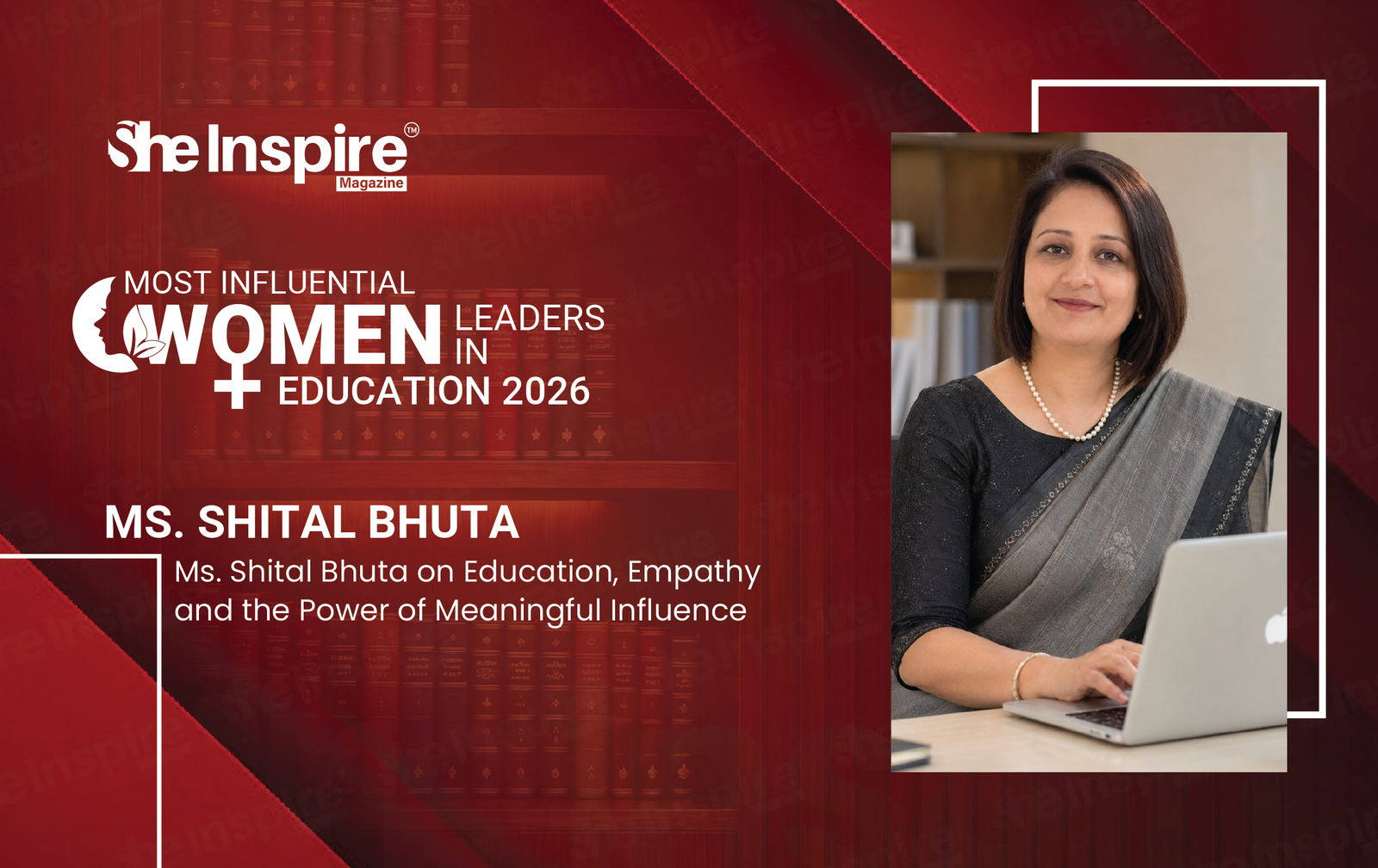
What does it really mean to influence a child?
For Ms. Shital Bhuta, the answer is not found in examination results alone.
It can be seen in the moment a hesitant child finally raises a hand.
In the moment a student who once doubted herself begins to share an idea.
In the moment curiosity replaces fear.
And perhaps most importantly, it can be heard years later when a former student remembers the teacher who believed in them.
This philosophy has shaped Ms. Shital Bhuta’s 15-plus-year journey in education.
An educator and Class Coordinator at C.N.M. School, Vile Parle West, she has evolved from classroom teaching into academic coordination, student enrichment, experiential learning and mentorship. Her work reflects a simple conviction: education should not merely produce knowledgeable students; it should help create confident, compassionate and responsible human beings.
A Journey Built Around Growth
Ms. Bhuta’s professional journey began as a Pre-Primary Educator at C.N.M. School & N.D. Parekh Pre-Primary School.
Those early years brought her close to children during some of their most formative stages. It was here that she experienced first-hand how deeply a teacher can influence a child’s relationship with learning.
She later gained experience in secondary education at M.P. Shah English High School, broadening her understanding of different learners, developmental stages and pedagogical approaches.
A significant transition came when she took on the role of Class Coordinator at C.N.M. School & N.D. Parekh Pre-Primary School.
The new responsibility expanded her perspective.
She was no longer concerned only with what happened within her own classroom. Curriculum planning, teacher mentoring, academic development and the holistic growth of students became part of her professional world.
That evolution helped shape an important principle in her leadership philosophy: educational leadership is not about directing people.
It is about empowering them.
Influence Beyond a Designation
Ms. Bhuta does not see the term “influential woman leader” as a title to be displayed.
She sees it as a responsibility.
For her, influence comes from purpose, integrity and example. It is about being open to new ideas, challenging conventional thinking and constantly looking for better ways of doing things—while retaining the empathy to understand different perspectives.
Her measure of leadership is therefore deeply human.
If her journey encourages another teacher to believe in herself, inspires a child to recognise her own potential, or contributes to a more progressive learning environment, she considers that influence meaningful.
Her ambition is not simply to leave behind achievements.
She wants to leave behind confidence, compassion and possibility.
Measuring Success One Child at a Time
The achievements Ms. Bhuta values most are not necessarily the easiest ones to put on a certificate.
As a Class Coordinator and Academic & Student Enrichment Facilitator, she has contributed to academic planning, experiential learning, student enrichment and the creation of engaging learning experiences.
But she measures impact differently.
She notices the small transformations.
A hesitant student finding her voice.
A child discovering an ability she did not know she possessed.
A classroom becoming a place where students feel their ideas matter.
For her, those moments are evidence that education is working.
That philosophy also explains why she believes learning must move beyond information.
Students need critical thinking, creativity, communication, collaboration and emotional intelligence. They need opportunities to question, explore and apply what they learn to real situations.
The objective should not be to create students who can simply perform well in examinations.
It should be to prepare individuals who can navigate life.
Innovation Begins with Understanding the Learner
Ms. Bhuta’s approach to educational innovation is refreshingly practical.
She does not believe innovation simply means adding more technology to a classroom.
For her, innovation begins by understanding how children learn.
Some students respond to visual learning. Others understand better through listening and discussion. Some learn most effectively when they are physically involved in an activity.
Her response is not to force every child into one method.
Instead, she brings together visual, auditory and kinaesthetic approaches.
Stories, role plays, presentations, discussions, activities, demonstrations, collaborative tasks and digital resources become different pathways to the same learning objective.
That philosophy can be summarised simply:
Different methods to reach every child.
Technology has a role to play, but it remains a tool.
The teacher’s understanding of the child remains central.
Leadership That Listens
Ms. Bhuta describes herself as an empathetic, collaborative and supportive leader.
Listening is an important part of her approach.
She believes educators and team members should feel respected and heard, and she encourages ownership rather than simply issuing instructions.
Accountability, in her view, should exist alongside compassion.
This is particularly visible in her belief in distributive leadership—giving people responsibility, ownership and opportunities to make decisions and grow.
She also believes institutional culture directly affects students.
When teachers feel respected, happy and motivated, that positivity naturally reaches the classroom.
For her, leadership rests on three values:
Trust. Collaboration. Positivity.
It is a model of leadership that seeks to create not just efficient institutions, but healthy ones.
Creating Global Classrooms
Some of Ms. Bhuta’s initiatives demonstrate how learning can expand beyond geographical boundaries.
As part of the RIDS Certification programme with the British Council, she collaborated with a partner school in Kazakhstan, exploring cultural festivals, traditions and cross-cultural understanding.
She has also collaborated with schools in Serbia and Ukraine on climate-action initiatives, encouraging students to engage with global issues and understand shared responsibility.
Her work with students at inter-school science exhibitions has further encouraged research, creativity, collaboration and confidence.
These initiatives reflect her belief that children should not learn about the world only through textbooks.
They should experience it.
They should ask questions about it.
And, where possible, they should see themselves as participants in shaping it.
Recognition with Responsibility
Among the recognitions Ms. Bhuta has received, the Nation Builder Award (2017), presented by Inner Wheel & Rotary India Literacy Mission, holds particular significance.
She has also been honoured by OCER, Andheri, for her contribution to education.
Yet she does not see awards as the final measure of a teacher’s worth.
Her greater recognition comes from students, parents and colleagues.
Awards celebrate a moment.
Impact lasts longer.
That distinction is central to her understanding of education.
Preparing Children for a Future That Has Not Been Written Yet
Ms. Bhuta believes the future of education lies in moving from information-driven learning to skill-oriented learning.
Children must learn how to adapt.
They must know how to collaborate, communicate, think critically and manage emotions.
They should be allowed to make mistakes without feeling that mistakes define them.
And as Artificial Intelligence becomes increasingly present in education, she believes teachers will become even more important—not less.
AI can provide information.
But teachers help children understand what information means.
They teach judgement.
They nurture values.
They help students question answers rather than accepting them automatically.
For Ms. Bhuta, the real challenge is not simply teaching children how to use AI.
It is teaching them how to think when AI can provide the answers.
That is where human education remains irreplaceable.
A Future of Happier Children and Better Teachers
Her future vision is remarkably human.
She wants academic excellence and holistic development to exist together.
She wants learning to remain experiential, interdisciplinary and future-focused, while retaining human connection.
Most importantly, she wants children to feel safe enough to question, explore and discover their strengths.
She wants classrooms where students are active participants rather than passive recipients.
And she wants education to prepare children not only for professional success, but for life—with resilience, empathy, responsibility and purpose.
Her advice to young women is equally grounded.
Believe in your potential.
Remain curious.
Never stop learning.
Do not wait for someone else to validate your capabilities.
Build your expertise, but build your voice too.
And do not measure your journey only by positions.
Measure it by the difference you make.
Her chosen philosophy comes from Rabindranath Tagore:
“The highest education is that which does not merely give us information but makes our life in harmony with all existence.”
It captures the essence of her own educational journey.
Because for Ms. Shital Bhuta, education is ultimately not about filling minds.
It is about helping young people understand who they are, what they can become and how they can contribute to the world around them.
And if, years later, a student remembers not only the lesson but the confidence a teacher gave them, perhaps that is the most meaningful lesson of all.