
She Paused, She Restarted, and She Kept Climbing
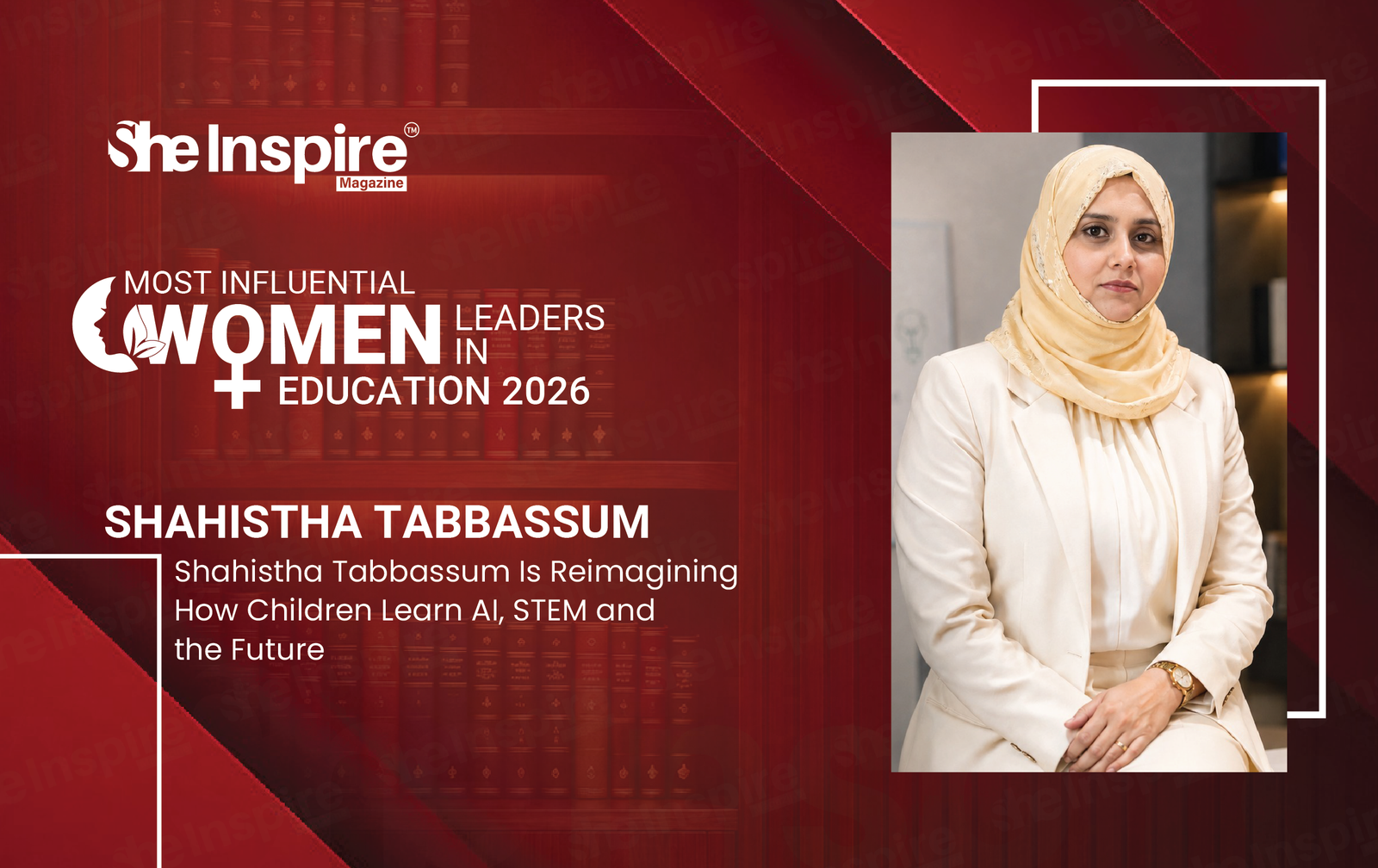
There's a moment every educator quietly waits for. It isn't the top score on a test, or the gold star on a report card. It's smaller than that, and stranger the exact second a child's face changes because something they built, coded, or tinkered with, suddenly works. For Shahistha Tabbassum, that flicker of “wait, it actually works” is the whole point of education, and it's the thread running through a career that has taken her from Computer Science classrooms in India to robotics labs in the Gulf, and now into the heart of one of India's fastest-growing AI education platforms.
An AI Curriculum SME with more than six years across K-12 education, curriculum design, robotics, and educator training, Shahistha's journey reads less like a straight climb and more like a series of honest reinventions from ICT classrooms in the UAE and Qatar, back to India for a stretch spent rebuilding training programmes and STEM leadership from the ground up, and now into AI-focused EdTech. But underneath the job titles is a quieter story: one of pausing for motherhood, and choosing to return anyway.
Where Curiosity Becomes Capability
Shahistha's first real connection to education came through Computer Science, but she'll tell you plainly it was never really about the technology. It was about the learner in front of her, and what happens in the space between a question and an answer. “A child starts with a question, experiments with an idea, fails, tries again and eventually, something works,” she says. That small arc, curiosity hardening into capability, shaped almost everything she's built since.
Over time, her role expanded the way careers sometimes do without anyone quite planning it; from teaching individual students, to designing full programmes, to training the educators who'd go on to teach those programmes themselves. Her years in the UAE and Qatar gave her a front-row seat to ICT and robotics education across very different school systems. Returning to India opened a different chapter altogether, one that pulled together operations, training, and STEM and AI leadership under one roof.
Today, at Bhanzu, she's channelling all of it into something built to scale; designing AI and Computational Thinking experiences for young learners, not one classroom at a time, but across many. Alongside the day job, she's deep into doctoral research on quantum-inspired approaches to STEM and AI pedagogy, and she's already the author of REWIRED: A Journey Through Spark, Syntax, and STEM. Laid out on paper, the different chapters of her career might look scattered. Lived through, they tell one coherent story of someone who keeps circling back to the exact point where technology meets learning.
Permission to Begin Again
Ask Shahistha what it means to be an influential woman leader, and she doesn't reach for the word “visibility.” She reaches for “permission” — permission to believe a career can have a second chapter, even a third. It's not an abstract idea for her. She stepped away from full-time work for a period to raise her children, a decision she doesn't regret for a moment. But coming back carried its own quiet weight the question so many women carry privately and rarely say out loud: will the field still want me?
The professional world tends to celebrate the unbroken career line, which can make any pause feel like something that needs defending. Shahistha chose a different response. Rather than explain away the break, she started naming what it had actually given her patience, perspective, a different kind of resilience. Rebuilding her professional footing wasn't effortless. But the pause became part of the story she tells, not a chapter she skips over.
It's why she's so direct with other women, particularly mothers who've stepped away from their careers: a break doesn't erase what you're capable of. It just changes the timeline. And because she's lived it, not just observed it from a distance, the message lands differently less like advice, more like evidence.
Where Technology Meets Learning
One of the quieter threads running through Shahistha's work is her refusal to treat technology and education as two separate worlds that occasionally intersect. Across AI-integrated STEM curriculum, robotics, educator training, and student mentoring, her instinct has never been to bolt a new tool onto an old lesson plan. She starts further back than that, asking the harder first-principles questions: How should AI even be introduced at different ages? How does robotics connect meaningfully to computational thinking? How does coding become a way of solving problems, rather than just a technical skill to check off? And, maybe most importantly how do educators become confident enough to teach emerging technology without feeling intimidated by it themselves?
Those questions sit underneath everything she builds AI-integrated lessons, prompt-engineering activities, project-based STEM modules for K-12 students, teacher-training programmes on robotics and AI-tool adoption, and mentoring through robotics competitions and innovation challenges. She's also volunteered her time toward robotics education for children from underserved communities, because access to this kind of learning, in her view, shouldn't depend on which school a child happens to walk into. Across all of it, one instinct stays constant: technology in a classroom should feel understandable and inviting, never something that quietly frightens a child or a teacher into staying away.
When Judgement Becomes the New Superpower
Shahistha has a clear-eyed view of what AI actually means for teachers and it isn't the story of quiet obsolescence some fear. She sees the role becoming more important, just differently important. “When information becomes abundant, judgement becomes valuable,” she says, and it's become something of a working philosophy for her. As AI tools flood into classrooms, she believes teachers will spend less time being the sole source of answers, and more time helping students ask sharper questions, weigh AI-generated answers critically, and sense when a piece of technology should and shouldn't be trusted.
For Shahistha, AI should be a starting point, never a shortcut. But that only works if teachers themselves are genuinely comfortable with the technology first, which is why she's convinced that schools serious about thriving in an AI-shaped future need to train their educators early, rather than treat AI as a threat to be managed. It's a simple enough logic, really: even the best-designed AI programme falls flat if the person delivering it doesn't feel equipped to bring it to life.
Curiosity Over Compliance
If one line sums up how Shahistha leads, it's this: curiosity over compliance. She'd take a teacher asking “why does this work?” over one quietly following a script, any day and she holds herself to the same standard, questioning her own assumptions as readily as anyone else's.
That philosophy softens into something gentler when it comes to people just starting out. A teacher using AI tools for the first time is often nervous, sometimes visibly so and what they need in that moment isn't perfection, it's patience. She extends the same grace to students. The goal was never to make anyone afraid of getting something wrong. It's to build just enough confidence to keep experimenting anyway.
The Trophies Aren't the Point
Shahistha's work hasn't gone unnoticed. She received the EdTech Integration & Author Award at the New Age Education Summit 2025, hosted by GTF India, and was ranked among the Top 500 educators globally in the 2024 International Digital Teachers Olympiad, after placing in the top 10 percentile of the 2022 edition. She's also represented educators as a panelist at the Qatar Inter-School Teachers Discussion Forum.
Impressive as the list reads, it isn't really what she leads with. Ask her what she's most interested in changing, and the answer has nothing to do with a ranking. It's about shifting how young people see technology in the first place from something they passively consume, to something they know how to build and shape themselves. That motivation, she'll admit, is deeply personal. Her own children are part of why she keeps doing this work.
Imperfect, On Purpose
Ask Shahistha about work-life balance and she won't pretend it's a solved problem. She describes it the way most working mothers quietly do imperfectly, and most days, a little chaotically. What's worked for her isn't chasing balance every single day, but protecting a handful of non-negotiables and letting the rest bend. She wants her children to see the effort as much as the outcome — a PhD, a book, a career, motherhood, none of it living in neat, separate boxes. Sometimes it's messy. That doesn't make it any less meaningful, and if anything, it's become one more thing she hopes her story quietly proves: a career doesn't need to look tidy from the outside to be considered successful.
Building Tomorrow's Classroom, Today
Looking ahead, Shahistha wants to help build education systems where AI, computational thinking, and emerging technology aren't bolted on as an afterthought, but woven into how learning actually works scalable, research-backed frameworks that hold up across curricula, age groups, and geographies. Finishing her PhD research on quantum-inspired STEM pedagogy matters just as much to her, and not simply as a line on a CV she wants the research itself to shape real classroom practice, not sit quietly in a thesis on a shelf.
The classroom she's building toward is one where curiosity is treated as a skill worth training, not a distraction to be managed where AI and robotics aren't fenced off into a separate “innovation lab,” but woven into how students question, create, and solve problems across every subject they touch. It's a bigger shift than it sounds: moving technology from the edges of education into its actual architecture.
Your Pace Isn't the Problem
The most personal part of Shahistha's story might be the message she leaves for other women. She isn't asking anyone to follow a straight line, because hers hasn't been one either there have been pauses, restarts, new qualifications picked up mid-career, entire new directions taken. Every stage, she says, added something to who she is now.
Her message, in the end, is simple:
“In a world shaped by technology and innovation, education must empower children not only to adapt to the future, but to create it.”
And to students, she offers something just as direct: you don't need to have all the answers. You just need to stay curious enough to keep asking better questions. Technology will keep changing. That instinct doesn't have to.
For women especially mothers wondering whether it's too late to start again her career offers a quiet answer: the destination doesn't get further away just because your pace looks different from everyone else's.
Shahistha paused. She restarted. And she's still climbing — which is exactly why her story belongs here: a reminder that a career was never meant to be a straight line, and a pause was never the end of ambition. Sometimes, it's simply where a stronger second chapter begins.