From Tribal Village to Rashtrapati Bhavan: the Inspiring journey of President Droupadi Murmu
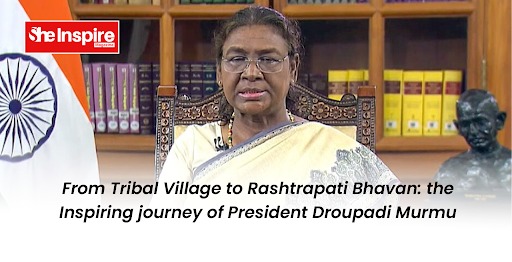
In a country as vast and diverse as India, the story of Droupadi Murmu stands apart- not as a political milestone, but as a human triumph over adversity. The woman who today holds the highest constitutional office in the land began her life in small tribal hamlet in Odisha, with no electricity, no privilege and no roadmap to power. Her journey is what India speaks of for generations.
A childhood shaped by struggle
Droupadi Murmu was born on June 20, 1958, to a Santhal tribal family in Uparbeda in the remote Mayurbhanj district of Odisha. In a community where girls were rarely encourages to study beyond the basics, the young Droupadi Murmu chose a different path. She became the first girl in her village to pass the matriculation examination and went on to earn a Bachelor of Arts degree in Political Science and Economics in 1979 from Ramadevi Women’s College, Bhubaneswar.
That degree was not just a certificate- it was a declaration. A declaration that tribal women too could dream, could study, could lead.
A teacher before a leader
Before she entered the corridor of power, she shaped the young minds in classroom. As a teacher she played a pivotal role in the lives of countless students, instilling in them the value of knowledge, resilience and compassion. Her early career also included administrative services- from 1979 to 1983 she served as a Junior Assistant in the Irrigation and Power Department, Government of Odisha. These years on ground gave her first hand understanding of governance, rural realities, and the gap that ordinary citizen face in accessing basic rights.
Loss as the price of purpose
Droupadi Murmu journey was not simply one of scholastic achievements and political ascent. It was forged in grief that would have ended most people’s public lives entirely.
Within the span of few years, she lost her whole family. The personal toll was staggering. After every loss- she stepped back and then she stepped forward again. Those who know her describe her defining trait ability to absorb the pain and convert it into a purpose. A lesser people might have used that grief as a reason to withdraw. But Droupadi Murmu used it as fuel.
She served as a two-term MLA from Odisha, then made history again in 2015 when she became the first woman governor from tribal community of Jharkhand. In that role she demonstrated early that her compass point towards the marginalized: she actively opposed the amendment that would have enabled commercial exploitation of tribal land and the government were forced to withdraw it.
On July 25 2022, India wrote a new chapter in Democratic history, Droupadi Murmu become the – 15th President of India – the first person from tribal community and only second woman after Pratibha Patil to hold the office.
“I started my life journey from a small tribal village. From the background I come from, it was like a dream for me to even get elementary education. But despite many obstacles, my resolve remaining strong.”
- Smt Droupadi Murmu
A presidency of outreach and dignity
President Murmu has used her office not just symbolically, but actively. As President she has travelled widely across India and abroad to enhance the country global reach. She has visited United Kingdom, Vatican City, Mauritius, Fiji, New Zealand and several other nations. In each visit she has made a point of meeting the Indian diaspora, reinforces cultural bond and bilateral ties.
At home she has consistently championed the cause of education, women empowerment, and the welfare of marginalized communities. Prime Minister Narender Modi has publicly praised her “exemplary service and dedication to the nation.”
The Investiture and what it means
On June 9,2026 President Murmu presided over phase – 1 of Defence Investiture Ceremony 2026 at the Rashtrapati Bhavan- conferring 51 Gallantry Awards, including six posthumous honors. Among them were seven Kirti Chakras, 15 Vir Chakras and 29 Shaurya Chakras. India wartime gallantry decoration, awarded to Army and Air Force personnel for outstanding courage during military operations.
Pinning a Kriti Chakra’s to a soldier’s chest, or handing a Shaurya Chakra to the family, is not a ceremonial act for Droupadi Murmu- it is a deeply personal one. She knows what it is to carry loss. She knows what is told to be your sacrifice will go unacknowledged.
A moment when the soldiers mothers stood up to collect India’s second highest peacetime gallantry award, the Kirti Chakra, on their behalf. As each woman walked up to receive the medal, the emotions they had held back throughout the morning finally surfaced. And that is when the President moved. She did not wait. She rose from her seat, stepped forward, took their hands in hers, and stayed with them for a moment in the entire hall.
she says that “gallantry awards are our gratitude to brave hearts.”
A presidency still being written.
President Murmu’s term will end in 2027. She will be remembered as India’s first tribal President but the more enduring legacy may be something quieter: the idea that highest office in the land belongs to all of India- including the girl from Uparbeda who was never supposed to make it out.
She is not just India’s President. She is proof that democracy- when it truly works- can lift even the most invisible voices to the very top.
Smt Droupadi Murmu’s dedication to nation building has remained steadfast, reflecting extraordinary resilience and strength. Her journey of perseverance and purpose continues to inspire and empowered India.