From a Tamil-Medium Classroom To a Life of Empowering Others
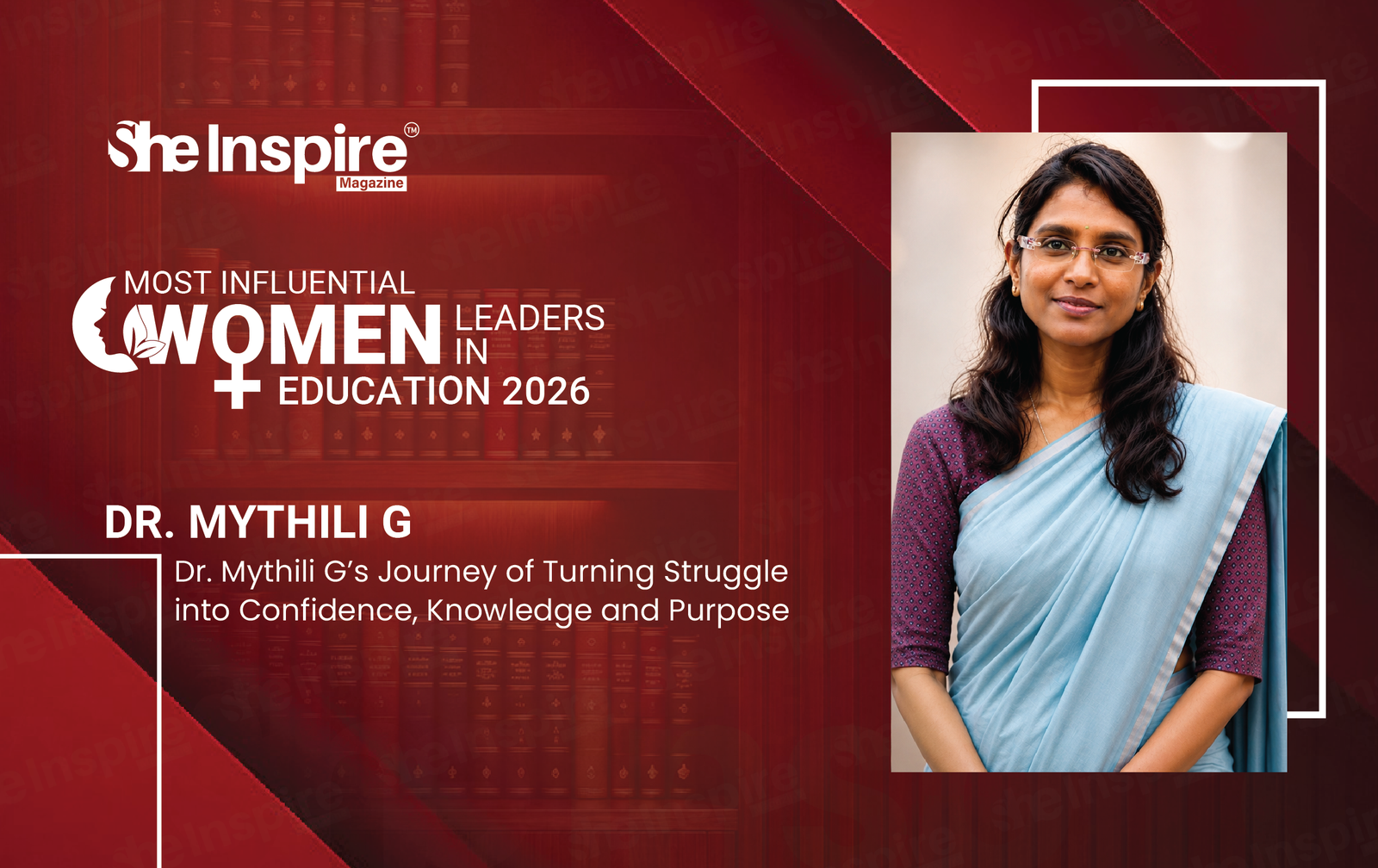
There are some journeys that begin with certainty. Others begin with struggle.
For Dr. Mythili G, the journey began with the latter.
The daughter of G. Prema and K. Gunasekaran, coming from a Tamil-medium schooling background in Udumalpet, Tirupur District, she entered an English-medium college carrying a challenge that many students quietly understand but few openly discuss—the fear of not being able to keep pace. Lectures, textbooks, conversations and an unfamiliar academic environment suddenly demanded a language she was still learning to navigate.
She had to fight, as she puts it, “word by word.”
But that experience did not become a limitation. It became the foundation of the educator she would eventually become.
Today, Dr. Mythili G serves as an Associate Professor and Physiotherapist at PPG College of Physiotherapy, Coimbatore, while pursuing her PhD in Neurological and Neurosurgical Rehabilitation. With more than seven years of teaching and clinical experience, she has guided undergraduate and postgraduate students, contributed to research, organised faculty development initiatives and taken on responsibilities that extend well beyond conventional classroom teaching.
Her story is ultimately about one powerful transformation: the student who once struggled to find confidence becoming the educator who helps others find theirs.
When the Struggle Became a Strength
Dr. Mythili’s academic foundation was built through her Bachelor of Physiotherapy at PSG College of Physiotherapy, Coimbatore, followed by her Master’s at KMCH College of Physiotherapy.
The transition from Tamil-medium schooling to an entirely English academic environment was not easy. Yet it taught her something that no textbook could have explained—that a difficult beginning does not determine the outcome of a journey.
Persistence does.
That lesson stayed with her when she entered teaching after completing her postgraduate studies. At that stage, she admits, she had limited experience in leadership, communication and organisation. Instead of seeing those gaps as reasons to hold herself back, she chose to learn.
A particularly important influence came from Prof. Dr. Pradeepa M, Principal, PPG College of Physiotherapy. Her mentor saw potential in her even before she fully recognised it herself and entrusted her with responsibilities that allowed her to develop.
Gradually, communication became confidence. Responsibility became leadership. Experience became perspective.
Over the years, Dr. Mythili has gone on to guide more than 100 undergraduate and postgraduate students, mentor more than 50 others in their academic and clinical growth, and continue her own doctoral research alongside her teaching responsibilities.
Her evolution is a reminder that leadership is rarely something that appears overnight. It is built quietly—through responsibility, learning and the willingness to keep improving.
More Than a Teacher
For Dr. Mythili, being an influential woman leader in education has little to do with a designation.
It is about representation.
She wants students from regional-language and modest backgrounds to understand that their starting point does not determine their destination. Her own experience gives authenticity to that message.
She knows what it feels like to enter a room and wonder whether you belong there. She knows what it means to struggle with language and confidence. And she knows that sometimes, what a student needs most is not another instruction but someone who says, in one form or another, keep going.
That belief has become central to her approach to education.
Her leadership style is built around quiet self-belief, discipline and consistency. She believes hardships—and even moments of humiliation—can eventually become sources of strength. Rather than allowing difficult experiences to diminish a person, she believes they can elevate them.
It is this philosophy that she tries to pass on to students and colleagues.
Building Professionals Beyond the Textbook
Dr. Mythili’s contribution to education has not remained confined to teaching lessons or completing academic requirements.
She has coordinated the Research and Innovation Club at PPG College of Physiotherapy and organised more than ten Faculty Development Programs focusing on communication skills, confidence-building, leadership, interpersonal skills and professional etiquette.
These subjects may not always appear on an examination paper, but they matter enormously once students enter professional life.
A technically competent professional who cannot communicate, collaborate or carry confidence into a clinical environment can find it difficult to translate knowledge into meaningful practice. Dr. Mythili therefore sees education as something larger than information transfer.
She has also organised a national-level quiz competition and driven an anti-drug awareness initiative on campus. Alongside these initiatives, she continues her doctoral research in neurological and neurosurgical physiotherapy, contributing to the academic side of the profession as she continues to teach.
Her work has also included a Scopus-indexed paper, several Google Scholar-indexed publications and presentations at eight conferences. She has applied for a patent and copyright as part of her ongoing research journey.
Recognition has followed as well, including a Best Teacher Award and an Appreciation Award at Aadukalam 2.0, along with honours associated with paper presentations and elocution events.
Yet the numbers and awards are only part of the story.
The larger contribution lies in the people she has helped prepare for their professional lives.
Education That Removes Barriers
One of Dr. Mythili’s strongest educational convictions comes directly from her own experience: language should never become a barrier to opportunity.
She believes India’s education system needs stronger bridging support for students moving from regional-language schooling into English-medium higher education. Academic institutions, in her view, must actively build communication skills, confidence and leadership qualities rather than treating them as optional extras.
This is especially relevant in professional education, where students are expected not only to know but also to communicate, make decisions and demonstrate confidence.
She sees emerging technology, including Artificial Intelligence, as a useful tool—but not a replacement for the human educator.
For her, technology should free teachers to spend more time doing what machines cannot replicate: mentoring, building confidence, exercising clinical judgement and helping students develop critical thinking and resilience.
That distinction is important.
The future educator, in her view, will not simply provide answers. She will help students learn how to think, communicate and respond when the answers are not obvious.
The Road Ahead
The next chapter of Dr. Mythili’s journey is already taking shape.
Completing her PhD remains an important priority, alongside continuing research in neurological and neurosurgical dysfunction. She is also looking ahead to a forthcoming publication that she is co-authoring.
But perhaps the more personal part of her vision is her desire to expand faculty development and mentoring initiatives.
She wants more students—especially those who come from backgrounds or language environments similar to hers—to receive the support, confidence and skills they need to succeed.
Her motivation remains deeply personal. She remembers the distance she has travelled, from struggling to follow lectures in an unfamiliar language to becoming an educator and researcher herself. The pride her achievements bring to her parents, G. Prema and K. Gunasekaran, matters to her, but so does the possibility that her journey might encourage another student who is currently struggling.
Her family, sister G. Yoga Priya, son and close friends have been important sources of support, while Prof. Dr. Pradeepa M has been a defining mentor in her professional growth.
There is a quiet humility in that perspective.
Dr. Mythili does not present success as something achieved alone. She sees it as a combination of persistence, guidance, support and continuous learning.
A Message for Every Woman Who Thinks Her Beginning Is Too Difficult
Perhaps the most powerful part of Dr. Mythili’s story is that she does not hide the difficult beginning.
She owns it.
And that makes her message particularly powerful for young women.
Her philosophy is simple:
“The struggles and humiliation you face today may become the first steps towards the success you achieve tomorrow.”
It is more than a motivational line. It is a reflection of her own journey.
From a Tamil-medium classroom to an English-medium college. From uncertainty in communication to academic leadership. From a student finding her own confidence to an educator helping others discover theirs.
Dr. Mythili G’s journey demonstrates that influence does not always begin with a grand position or a dramatic breakthrough.
Sometimes it begins with simply refusing to stop.
And sometimes, the person who once needed someone to believe in her becomes the very person who teaches an entire generation to believe in themselves.
Her story is a reminder that your starting point may shape your journey—but it does not have the power to decide your destination.