
Educating the Innovators of Tomorrow
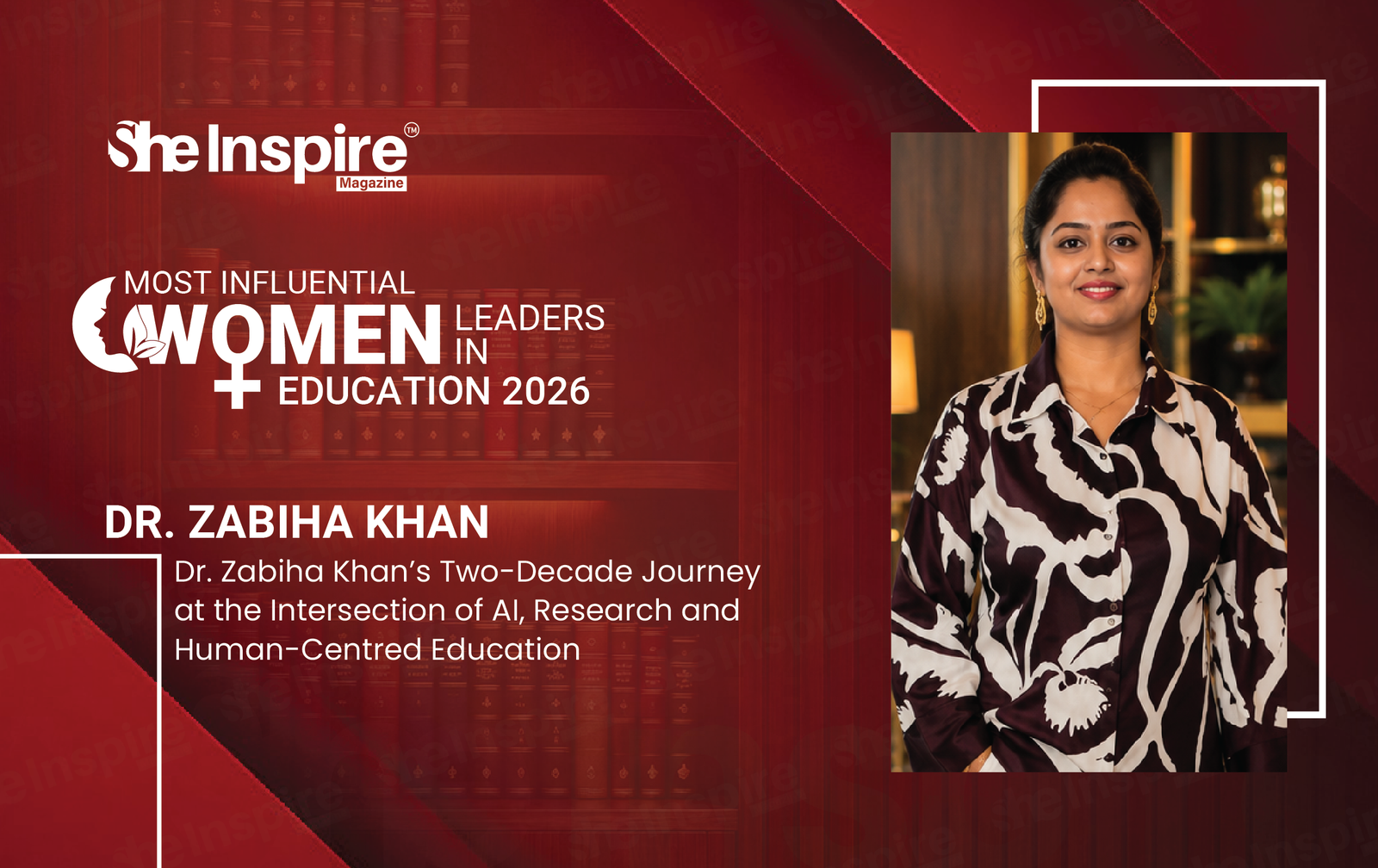
The world of technology changes quickly.
What is considered cutting-edge today can become standard tomorrow. New tools appear, old assumptions disappear, and educators are constantly challenged to prepare students for careers that may not even exist yet.
For Dr. Zabiha Khan, this pace of change has become not a reason to step back, but a reason to keep learning.
With 22 years of experience in education, Dr. Khan has built a career around three interconnected pursuits: teaching, research and empowerment.
An Associate Professor in Artificial Intelligence and Machine Learning at Nitte Meenakshi Institute of Technology, Bengaluru, she specialises in AI, Machine Learning, Deep Learning, medical image processing, software engineering and data analytics.
Her academic journey has taken her from core Computer Science education into emerging technologies and research, eventually bringing AI into healthcare and medical imaging.
But behind the technologies and publications is a philosophy that remains distinctly human: education should enable people to think independently, create solutions and become capable of helping others.
From Computer Science to AI and Healthcare
Dr. Khan’s academic background includes a B.E. and M.Tech in Computer Science and Engineering, followed by a PhD in Computer and Information Technology with a specialisation in Medical Image Processing.
Her early years in education were focused on core Computer Science subjects such as programming, computer graphics and systems engineering.
Those years taught her an important lesson.
Teaching is not simply about what an educator knows.
It is about how effectively students are enabled to understand, visualise and apply that knowledge.
As her career developed, her interests expanded.
Networking. Cloud computing. IoT. Neural networks. Artificial Intelligence. Machine Learning. Medical image processing.
Each transition added another layer to her understanding of education and technology.
The move into research was particularly significant because it allowed her to connect classroom learning with real-world problems.
Her doctoral work strengthened her research orientation and deepened her commitment to applying AI to meaningful healthcare challenges.
Today, that connection between knowledge and application remains central to her teaching and mentoring.
Leadership Beyond a Designation
Dr. Khan’s professional journey has also evolved from teaching to mentoring and institutional leadership.
She has served in roles including Class Coordinator, Website Coordinator, IIC Coordinator and NBA Coordinator, gaining experience across academic coordination and institutional development.
She has coordinated Faculty Development Programmes, delivered expert lectures and participated in academic initiatives that extend beyond her own institution.
Her expert sessions have covered subjects including AI in healthcare, AI in education, quantum computing, XR and Metaverse, parallel programming and other emerging technologies.
This breadth reflects one of her central beliefs: an educator cannot ask students to keep learning while remaining static herself.
Her own career demonstrates continuous reinvention.
She describes her journey in three broad stages: becoming a teacher, becoming a researcher and mentor, and then evolving into an academic leader who connects teaching, research, innovation and institutional development.
Educate. Mentor. Innovate. Empower.
Four words summarise Dr. Khan’s approach to education:
Educate. Mentor. Innovate. Empower.
For her, an educator’s contribution should extend beyond delivering contemporary knowledge.
It should develop independent thinkers.
She has guided UG, PG and PhD projects, supporting students in problem formulation, experimentation, research methodology, technical writing and publication.
The objective is not simply to help students complete a project.
It is to help them develop the confidence and capability to solve problems independently.
That philosophy extends to faculty as well.
Dr. Khan believes a leader should create more leaders.
When mentoring students or colleagues, she does not want to become the person everyone depends upon for answers. Instead, she wants to develop people who can eventually make decisions, solve problems and take ownership themselves.
That is empowerment in its most practical form.
Research That Reaches Beyond the Paper
Dr. Khan’s research profile reflects her commitment to connecting academic work with practical challenges.
Her publications include work appearing across Scopus, Springer, IEEE and other venues, including Q1 journal publications in areas such as cervical cancer screening, cerebral aneurysm prediction and aortic aneurysm prediction.
Her research and innovation work has also extended into patents related to automated liver tumour segmentation, deep-learning applications for cardiac disease detection, intelligent agriculture, medical imaging and other areas.
Among her recognitions are the Best Young Researcher Award – 2021 from Novel Research Academy, Puducherry.
She has also served as a Primary Evaluator for Toycathon 2021, associated with the Ministry of Education Innovation Cell, as a jury member for the National Hackathon-Neurocode and for the National Hackathon Eureka-26 zonals conducted by IIT Bombay.
She was a finalist for the Best PhD Thesis Award at the 8th International Conference on Computer Science and Information Technology in Smart Society at RV University in 2024.
She also received a Best Paper Award at ERCICAM-2024.
In 2024, she published the textbook “Next Generation IoT in Biomedical Engineering.”
These achievements are significant, but Dr. Khan does not treat recognition as an endpoint.
For her, every award represents an encouragement to continue learning and contributing—and a reflection of the students, collaborators, colleagues and institutions that have shared the journey.
Reimagining the Indian Classroom
Dr. Khan believes Indian education must gradually move beyond an examination-oriented model.
Competency, creativity, critical thinking, innovation, research and lifelong learning must become stronger priorities.
She advocates greater integration between theory and practice.
Students should work on real-world problems, projects, case studies, simulations, internships and interdisciplinary challenges.
Technology must also become part of the educational conversation.
AI, Machine Learning, Generative AI, robotics, cloud computing, cybersecurity, quantum computing, XR and data analytics are transforming professional life. Students therefore need technological awareness even outside traditionally technical disciplines.
But Dr. Khan is equally clear about responsible technology use.
AI literacy cannot mean merely knowing how to operate an AI tool.
Students need to understand its limitations, biases, reliability, ethical implications and appropriate academic use.
When Human Intelligence Meets Artificial Intelligence
Perhaps the most important part of Dr. Khan’s educational vision is her belief that AI will not replace educators.
It will redefine them.
She sees the future as a partnership between human intelligence and artificial intelligence.
AI can support personalised and adaptive learning. It can help identify individual learning needs and make educational experiences more responsive.
But a machine cannot fully understand the motivation, aspirations, emotional context and personal struggles of an individual learner.
That remains the educator’s responsibility.
Teachers will increasingly become mentors, facilitators, ethical guides and coaches for critical thinking.
The more information technology makes available, the more important judgement becomes.
And judgement is something education must consciously cultivate.
Creating an Ecosystem of Innovation
Dr. Khan’s initiatives reflect this broader vision.
She has introduced hands-on activities, AI-powered learning platforms, project-based learning and technology-enabled assessments. Students are encouraged to work on interdisciplinary problems rather than simply consume theoretical knowledge.
She has also promoted faculty development through FDPs, workshops, hands-on training and knowledge-sharing programmes covering Generative AI, AI in academics, RAG systems, AI-powered research tools, gamification and emerging technologies.
Research mentoring remains another major focus.
Students and research scholars are encouraged to publish, develop patents, participate in conferences and hackathons, and explore entrepreneurship and start-up opportunities.
The goal is to create an ecosystem where students become independent learners, faculty members continue upgrading their skills and institutions become centres of research and innovation.
The Educator Who Remains a Learner
Dr. Khan’s motivation comes from the belief that education is one of the strongest catalysts for individual transformation and social progress.
Technology itself provides another source of motivation.
The speed at which AI and emerging technologies evolve pushes her to continuously rethink conventional teaching methods.
Yet she insists that education must remain human-centred, ethical, inclusive and meaningful.
Her mentors, teachers, senior academics, research collaborators and colleagues have all contributed to that philosophy. Her students have also become teachers in their own way, constantly reminding her that every learner is different.
Their questions, creativity and aspirations have encouraged her to remain adaptable and student-centric.
That may be one of the most important qualities of a modern educator: the willingness to continue learning from the people one teaches.
Building the Future, Not Simply Preparing for It
Dr. Khan’s future vision is ambitious.
She wants to contribute to an innovative, research-driven, technology-enabled and globally competitive educational ecosystem.
She sees institutions where teaching, research, innovation, entrepreneurship and community engagement work together.
She wants every student to have the opportunity to discover their potential, every educator to be encouraged to innovate, and research to move beyond publication towards meaningful impact.
Her guiding philosophy is succinct:
“Learn continuously, lead with purpose, and leave every place better than you found it.”
It is a fitting philosophy for a career that has continuously evolved.
From Computer Science to AI.
From teaching to research.
From researcher to mentor.
From mentor to academic leader.
Dr. Zabiha Khan’s story is not simply about staying relevant in a rapidly changing technological world.
It is about ensuring that technology remains relevant to human needs.
And perhaps that is what makes her educational leadership particularly significant: she is not preparing students merely to enter the future.
She is encouraging them to develop the knowledge, imagination and responsibility required to shape it.