Colonel Sofiya Qureshi — The Signal Officer Who Rewrote the Rulebook
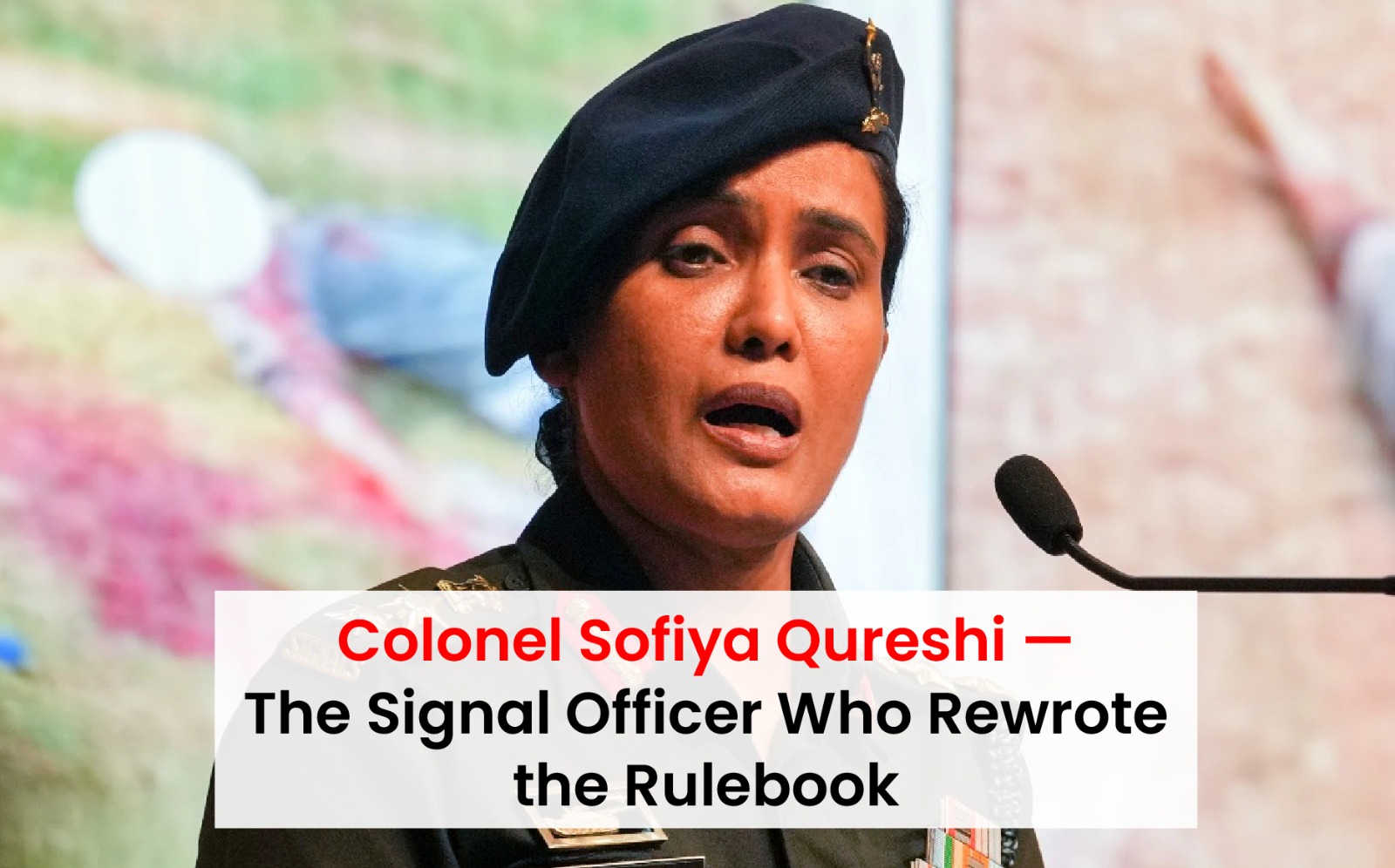
Colonel Sofiya Qureshi’s story reads like a modern blueprint for courage: steady, technical, and quietly audacious. Born and raised in Vadodara, Gujarat, in a family with a tradition of service, she took to science in her youth — earning a postgraduate degree in biochemistry from Maharaja Sayajirao University of Baroda — before choosing a different kind of frontline: the Indian Army. Her decision to join the Officers’ Training Academy in 1999 set her on a path that would repeatedly break ceilings for women in uniform.
An officer of the Corps of Signals, Col. Qureshi combined technical acumen with operational grit. Signals officers build the invisible backbone on which modern militaries operate — communications, cyber situational awareness and battlefield connectivity. In roles that demand both precision and composure, she served in counter-insurgency, disaster relief and even as part of United Nations peacekeeping in the Democratic Republic of Congo, where Indian officers typically manage communications, coordination and humanitarian support under complex multinational mandates. Those experiences sharpened her command skills and her ability to explain technically complex operations simply and credibly — a talent that would later matter on a national stage.
Trailblazer at multilateral drills: in 2016, then-Lieutenant Colonel Qureshi led India’s contingent at exercise force 18 — a multinational field exercise hosted by means of India — becoming the first female to do so. leading squaddies in multinational environments requires diplomatic instincts as a great deal as battlefield competence: you represent no longer just your unit however your state. Her leadership there despatched a clean message — girls officials have been not just able to group of workers or assist roles; they might command, coordinate and lead in complex, multinational settings.
Col. Qureshi’s profile rose sharply in 2025 during the events that followed the Pahalgam terror attack. She co-briefed the nation as part of the official team for “Operation Sindoor”, alongside other senior officials — a rare and high-visibility role for an army officer, and almost unprecedented for a woman at that rank and in that domain. Her clear, authoritative briefings combined operational facts with strategic restraint, and they reinforced public trust at a fractious moment. The Supreme Court has, in earlier landmark rulings on women’s Permanent Commission (PC) in the Army, explicitly cited her career as an example of women’s contribution and competence — recognition that helped shape policy and legal precedent.
Her career isn't always barring the modern-day hazards that come with reputation inside the social media age. As her visibility grew, so did incorrect information — deepfakes and pretend social money owed circulated false videos and inflammatory claims approximately her and her circle of relatives. authorities and fact-checkers flagged numerous of these as fabricated; the clicking statistics Bureau and information stores entreated the general public to rely on reliable channels and warned towards impersonation. That episode underscored a new fact for public servants: operational leadership now desires virtual resilience as much as tactical clarity.
What makes Col. Sofiya Qureshi an especially potent inspiration for readers of She Inspire is the blend of technical expertise, steadfast humility and symbolic leadership she embodies. She isn't always a superstar popular; she is a alerts officer who rose thru logistic, communications and subject assignments — the form of career that rewards quiet competence over publicity. yet whilst the nation wanted clarity, she progressed and communicated with the calm authority that solely comes from lived experience. For younger women considering the defense force, era careers, or management in traditionally male domain names…