
Beyond Marks: The Educator Who Teaches Children to Believe in Themselves
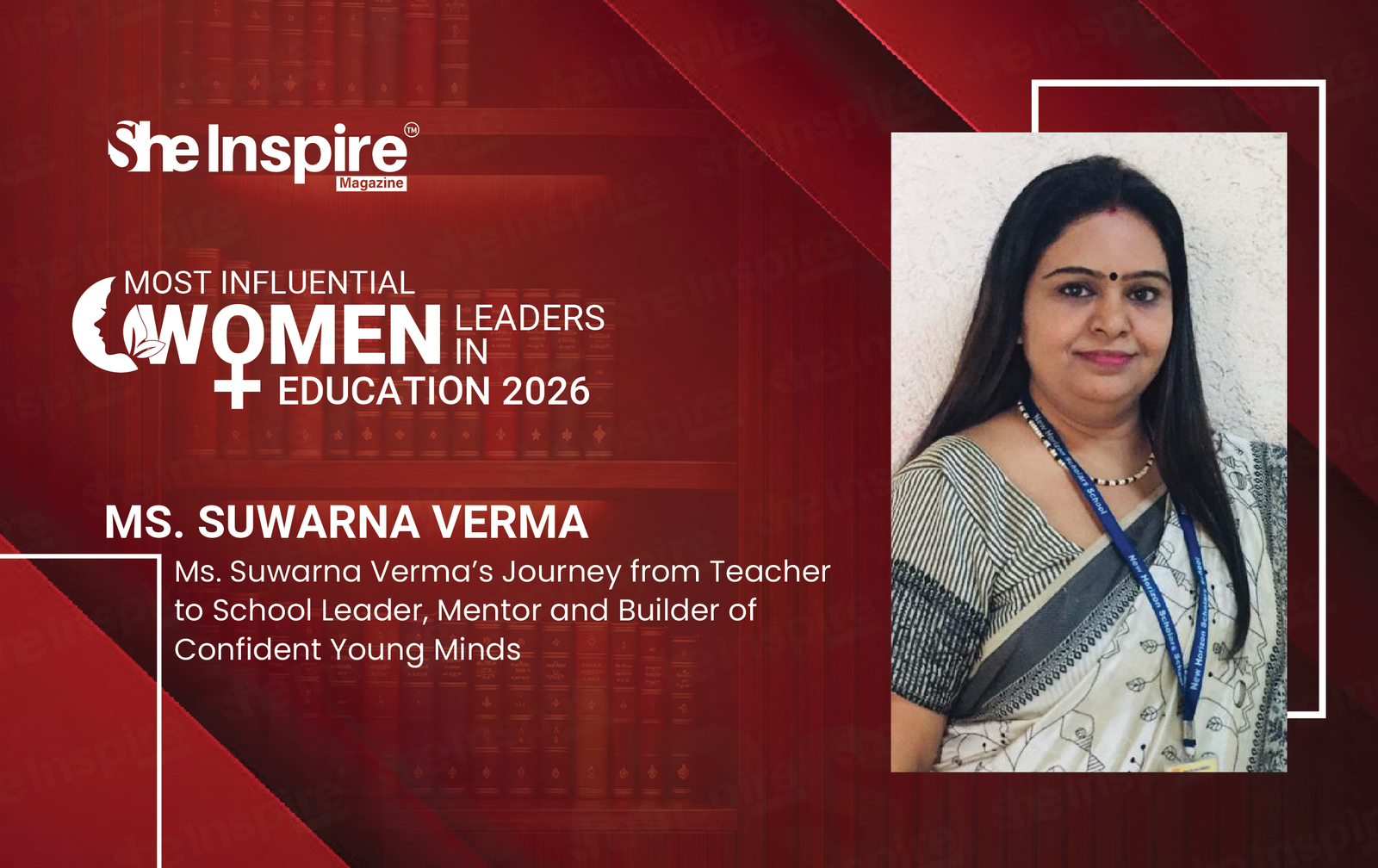
Ms. Suwarna Verma’s Journey from Teacher to School Leader, Mentor and Builder of Confident Young Minds
Not every child who struggles is destined to remain an average learner.
Sometimes, what appears to be an academic limitation is simply a child waiting for someone to recognise a different strength.
Ms. Suwarna Verma has spent much of her 14-year journey in education doing exactly that—looking beyond the marks to understand the child.
Currently serving as Vice Principal at New Horizon Scholars School, Thane, her journey in education began naturally.
Her mother was a teacher.
From childhood, Suwarna felt drawn towards teaching and working with children. Interestingly, she describes herself as not having been a particularly strong academic student herself.
But she was observant.
And that experience of being a learner shaped the educator she would become.
She understood early that learning should not be something children fear.
It should be something they can experience with curiosity, confidence and even joy.
The Teacher Who Understands the Struggling Child
Suwarna’s philosophy begins with a simple question:
What happens to the child who is not already among the top performers?
Her answer is clear—the child needs even more attention.
She believes educators have a special responsibility towards learners who need additional patience, encouragement and support.
Over the years, she has become particularly invested in students who consider themselves “average”.
Her aim is not simply to improve their marks.
It is to help them recognise strengths they may not yet see in themselves.
When such students eventually score above 95% in board examinations, the achievement is certainly gratifying.
But for Suwarna, the more meaningful transformation is internal.
A student who once believed, I cannot, begins to believe, perhaps I can.
That change can influence an entire life.
A Career Spanning Every Stage of School Life
Suwarna’s professional journey has given her a broad understanding of childhood and adolescence because she has had the opportunity to teach across almost every section of a school.
From Pre-Primary and Primary to Secondary and Higher Secondary, she has experienced different age groups and the different developmental, emotional and learning needs associated with them.
That breadth has shaped her leadership.
As an English teacher, she initially understood her role largely through language and communication.
But experience taught her that a teacher’s influence can extend far beyond a subject.
One of the moments that changed her perspective came through a message from a former student who had successfully cleared the IIT entrance examination.
Suwarna was not his Science or Mathematics teacher.
Yet he credited her as an important part of his journey.
That message stayed with her.
It demonstrated that a teacher does not necessarily influence a student only through the subject they teach.
Sometimes the greater contribution is motivation.
Mentorship.
Confidence.
Belief.
That realisation helped move Suwarna from seeing herself simply as an English teacher to understanding her role as a mentor and education leader.
Leadership That Makes Room for People
Suwarna describes herself as a democratic, supportive and distributive leader.
She does not believe the leader should be the person with every answer.
Instead, she believes the strongest institutions are built when people feel valued, heard and empowered to contribute.
She encourages open communication and seeks the perspectives of her educators and team members.
For her, collective wisdom often produces stronger decisions.
Her approach to leadership also includes giving people responsibility and ownership.
Delegation, in her view, is not simply about distributing workload.
It is about giving others the opportunity to make decisions, take initiative and develop as leaders.
At the centre of all this is institutional culture.
She believes teachers who feel respected, happy and motivated are more likely to create the same positive atmosphere for students.
That is why trust, collaboration and positivity are central to her leadership philosophy.
Teaching English as a Tool for Confidence
One of Suwarna’s significant professional recognitions has been the Best Teacher Award for Teaching English at the Asia Education Conclave.
She also received recognition for Excellence in Teaching English.
For her, these recognitions carry a deeper meaning because English has never been merely a subject.
She sees language as a tool.
A tool through which children communicate.
Express themselves.
Build confidence.
Find their voice.
Her approach to teaching has therefore focused on making language meaningful and accessible.
She does not believe effective teaching is simply about completing a syllabus.
It is about helping a child understand.
And one sentence from a student has stayed with her:
“When you teach, I understand everything better.”
For Suwarna, those words carry a significance that no trophy can quite match.
They tell her that the lesson reached the child.
Education for Living, Not Just Earning
Suwarna believes Indian education needs to bring values, purpose and holistic development back to the centre.
She recognises the importance of academic and career success, but believes education should offer children something more.
It should help them become compassionate.
Responsible.
Confident.
Ethical.
Resilient.
In her view, society can sometimes become too focused on marks, degrees, careers and financial success.
The danger is that children may become professionally successful while losing touch with empathy, gratitude, respect, integrity and social responsibility.
That is why she makes an important distinction:
Education should move from “education for earning” towards “education for living.”
The objective should be to prepare children not only to make a living, but to build meaningful lives.
That philosophy is central to the kind of school culture she wants to create.
Innovation Means Reaching Different Learners
For Suwarna, educational innovation does not simply mean introducing the latest technology.
It begins by accepting that children learn differently.
Some respond to visual learning.
Some understand better through listening and discussion.
Others need to participate actively.
Her teaching approach therefore brings together visual, auditory and kinaesthetic methods.
Presentations.
Stories.
Discussions.
Role plays.
Activities.
Demonstrations.
Collaborative tasks.
Digital resources.
Each creates another pathway to understanding.
Technology can strengthen this process, but she believes it should enhance the teacher’s work rather than replace the teacher’s understanding of the child.
In her words, true modernisation means moving from one method for every child to different methods that help reach every child.
That is an inclusive idea at its core.
Small Initiatives, Lasting Lessons
Some of Suwarna’s initiatives may appear simple.
That is precisely what makes them interesting.
She introduced a Discipline Oath during school assembly where students pledge not to hurt anyone, respect everyone and take responsibility for their words and actions.
Her approach to discipline is not based simply on punishment.
She wants children to understand why values matter.
She has also encouraged healthy competition through a “Hall of Fame” initiative, where student achievements and talents are recognised.
The purpose is not simply to celebrate the highest achievers.
It is to motivate students to participate, set goals and take pride in progress.
Another practice is random reading, where students may be called upon based on their roll number or the initial letter of their name.
The practice keeps students attentive while developing reading, pronunciation, communication and confidence.
None of these initiatives is complicated.
But together they demonstrate something important about education: culture is built through small actions repeated consistently.
Suwarna wants students to be disciplined without fear, competitive without unhealthy comparison and confident enough to participate without hesitation.
The Real Measure of Excellence
What motivates her most is the trust and affection of her students.
She wants to see children become more capable—not only academically, but also in confidence, communication, thinking and their ability to face challenges independently.
She does not want success to belong only to a small group of high achievers.
Her ambition is to help the maximum number of students reach their own potential.
For her, even a small improvement can represent a meaningful achievement.
That philosophy explains why she sees the teacher’s role as a continuous journey.
Students improve.
Teachers must improve too.
Education evolves.
Educators must evolve with it.
A School Where Children Are Happy to Belong
Suwarna’s future vision begins not with rankings, technology or infrastructure.
It begins with happiness.
She wants to create a positive school environment where children feel safe, respected and motivated to come to school.
She wants them to have good memories of childhood.
Because school should not become so dominated by competition that children lose the joy of being children.
For teachers, she wants a culture of continuous learning and professional growth.
Technology and AI are changing education rapidly, and educators must keep upgrading themselves.
But she also wants the human connection at the heart of teaching to remain strong.
Her vision can be summarised in four ideas:
Better teachers.
Happier children.
Stronger values.
Continuously improving learning outcomes.
It is a simple vision, but a deeply meaningful one.
The Leadership Legacy She Wants to Leave
Suwarna’s journey began with a mother who was a teacher.
It continued through classrooms filled with different age groups, different personalities and different learning needs.
It evolved through English teaching, mentorship, coordination and eventually school leadership.
But her central purpose has remained remarkably consistent.
Believe in the child.
Listen to the child.
Support the child.
And help the child believe in herself.
For young women entering education, her journey offers an important lesson about commitment.
Teaching is not an easy or part-time profession simply because many women work in it.
It demands time.
Energy.
Continuous learning.
And a willingness to care deeply about outcomes that may not always be visible immediately.
The greatest reward may arrive years later, through a former student who remembers the teacher who believed in them.
That is perhaps the most fitting measure of Suwarna Verma’s influence.
Not the number of lessons taught.
Not the number of years served.
But the number of young people who left her classroom believing they were capable of more.
Her story reminds us that sometimes the most powerful thing a teacher can give a child is not an answer.
It is confidence.
And sometimes, that confidence becomes the beginning of everything that comes next.